

Part 6 of 11 · Article Series
A Journey Through the Jins
This article is part of our 11-part series on the Jins in the Internal Arts.
You can start from the beginning or jump to any part using the links below.
If there happened to be a large, inflated ball settled peacefully against a wall in front of you and you happened to decide to take a run at it, you may or may not be surprised to find yourself, shortly afterwards, sitting on your backside in a different part of the room. The more inflated the ball is, the more likely it is to spin on its axis and introduce you to the wall behind it, while a slightly under-inflated, squishier nature may cause it to yield just a little before it pings you backwards the way you came. Either way, the faster you run at it, the more rapid your education on the laws of physics is likely to progress. From its point of view, the ball doesn’t care, it just stands around happily being a ball, doing what balls do the best: spinning and bouncing. If the ball were to take up martial arts, it might find itself to be very good at things like rolling back (Lu Jin) and pressing (Ji Jin) because of its inherent inflated state (Peng Jin).
While balls don’t normally decide to take up martial arts, of course, there is no reason why martial artists shouldn’t emulate the undoubted natural talents of the ball.
In Tai Chi, we are instructed never to meet force with force, but there are lots of more useful things we can do instead, one of which is to meet force with bounce!
This is particularly recommended in a situation where a villain up to no good tries to pin you against a wall. Their body might be so close that you are barely able to get your arms in front of your chest but, even without them, there are things you can do, such as getting one foot further forwards, sinking down and using your thigh muscles to transfer the whole weight of your body forwards into your front leg to start to unbalance them.
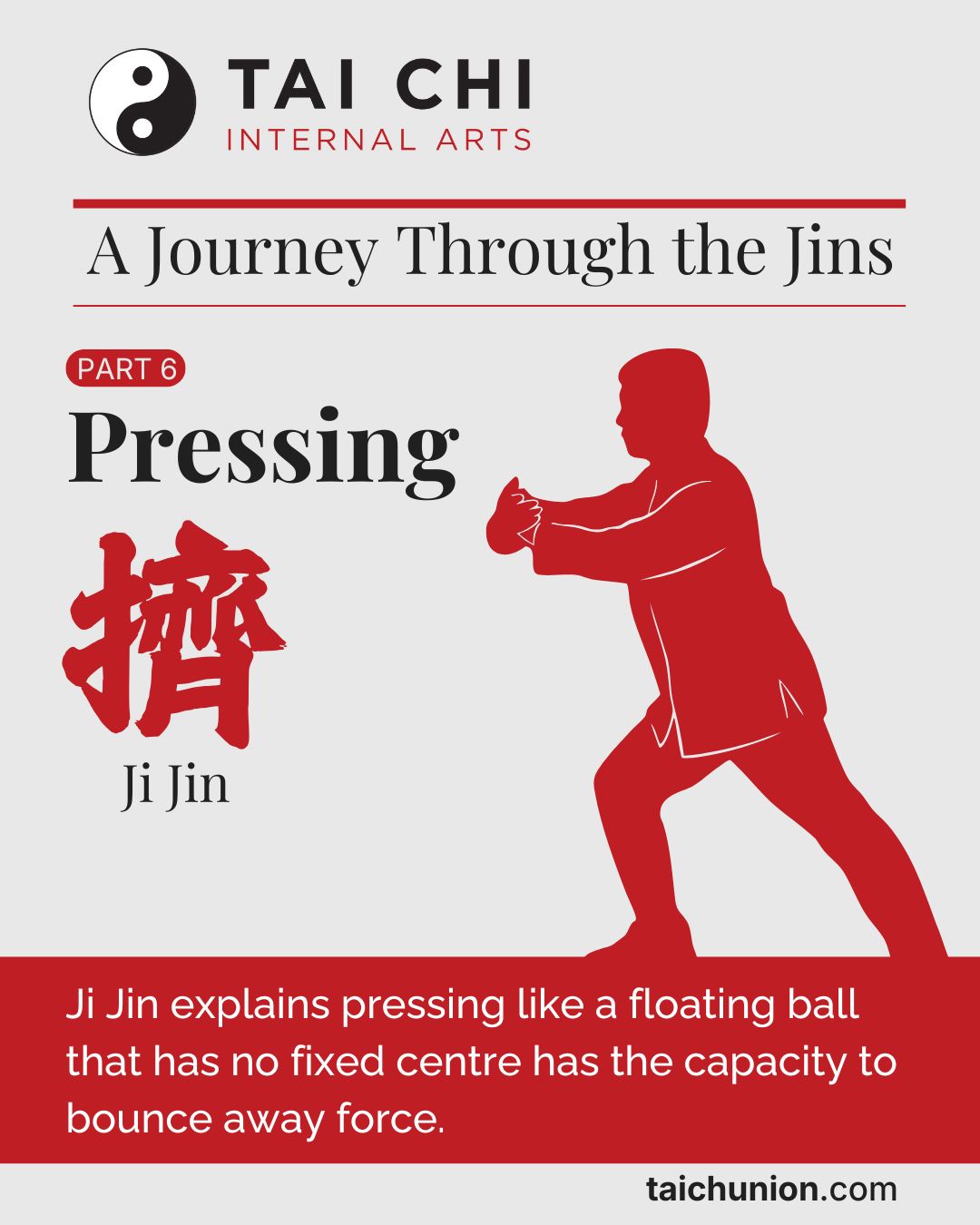
A press is basically a ward-off with your ward-off arm reinforced by your other hand. If you can get your hands in front of your chest, and overlap your hands or wrists, you have thus made a strong and stable circular structure, inflatable with Peng Jin, that is soft enough to yield a little to an incoming force and then ping it away horizontally, like a coin bouncing off a drum, as it says in the famous “Songs of the Eight Ways”. You achieve this effect by allowing the opening and closing of your joints to synchronise with your breathing, which the Classics describe as being “like an accordion, folding and unfolding”.
Ideally you might bounce your opponent away from you sufficiently to knock them over with your press, delivered with a bit of explosive Fa Jin, or you might follow up with a double-handed push (An) if necessary.
At the very least, your press might open up a space between yourself and the assailant so that you can follow up with some other action, such as a back fist strike to the nose or groin or a kick to the shin or knee. Much would depend on the situation and the nature of the assailant and their particular intentions. Obviously, there’s a world of difference between some random bloke in a dark alley and a confused elderly resident in a care home (all presupposing that neither of them is carrying a weapon).
In a competition or friendly push hands bout, there would be no wall to contend with, but the ball analogy is still useful. The word “Ji” can also mean “joining” or “connecting”, and you can look at this in two ways. The first could be the joining of your arms as your hands come together to form the protective bouncy circle. Another interpretation might be the meeting of your arms with your opponent, through which your whole body is able to sense and respond to their intentions. It may be that you have opportunities for your hands, wrists or arms to unite as they absorb and repel the incoming force. One example of this would be following a roll-back. Your opponent is already unbalanced and on their way past you and a timely press at right angles to their current trajectory might be warranted to help them on their way.
As with all of the skills we have mentioned so far, if you become tense and stiff, they are unlikely to work out well for you. The important thing is to remain relaxed, balanced and rooted so that you can maintain your centre of gravity as you absorb the weight of your opponent into your inflated ball of Peng Jin and let them bounce themselves away from you.