
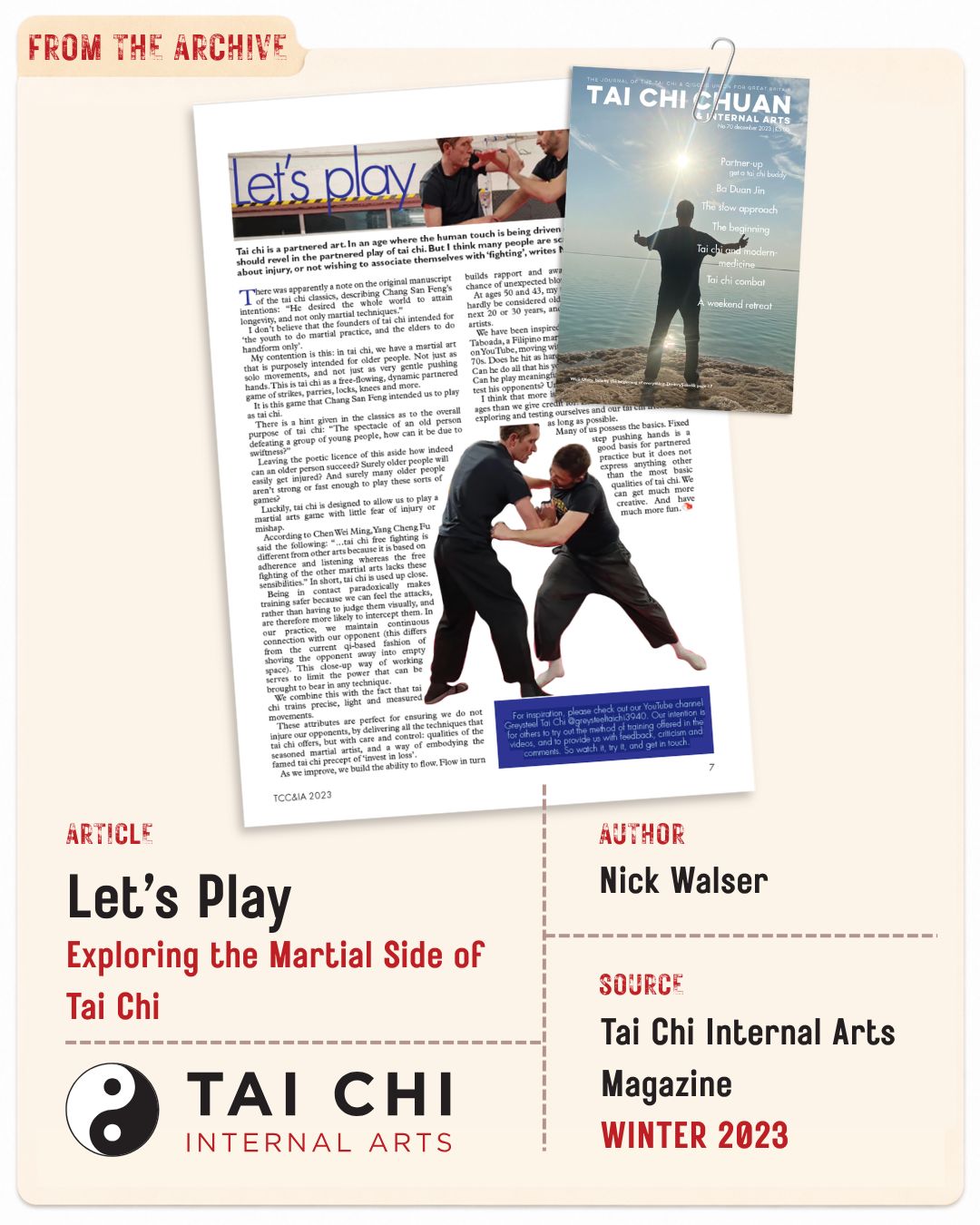
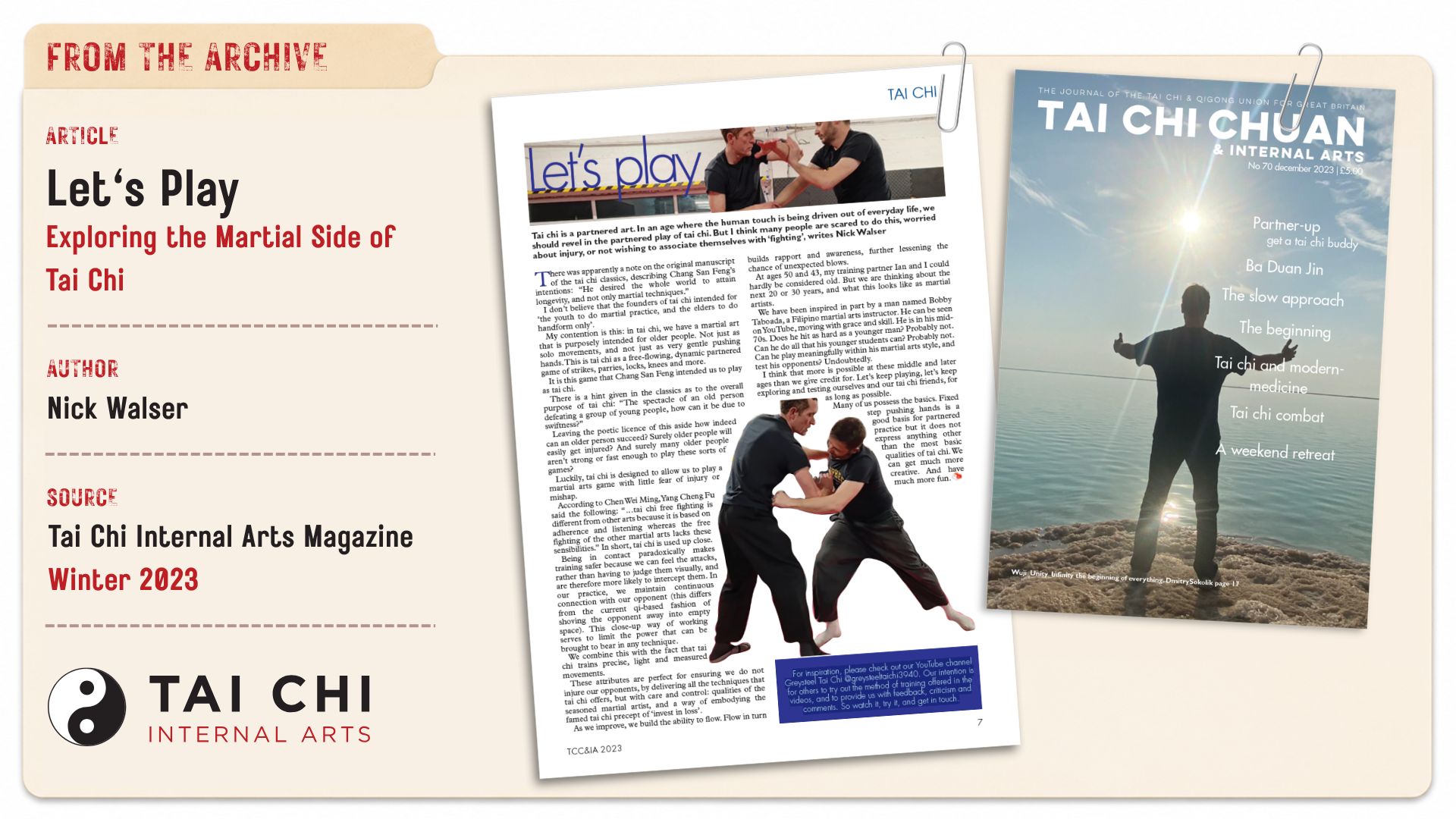
This article by Nick Walser was first published as “Let’s Play” in the Winter 2023 issue of the Tai Chi & Internal Arts Union magazine. It discusses the enjoyment and possibilities of partnered martial practice, and how this kind of training doesn't have to end as practitioners grow older.
We are sharing it here as part of our From the TCIA Magazine Archive series. The original text is presented in full, exactly as it appeared, to preserve the author’s insights.
Tai chi is a partnered art. In an age where the human touch is being driven out of everyday life, we should revel in the partnered play of tai chi. But I think many people are scared to do this, worried about injury, or not wishing to associate themselves with ‘fighting’, writes Nick Walser
There was apparently a note on the original manuscript of the tai chi classics, describing Chang San Feng’s intentions: “He desired the whole world to attain longevity, and not only martial techniques.”
I don’t believe that the founders of tai chi intended for ‘the youth to do martial practice, and the elders to do handform only’.
My contention is this: in tai chi, we have a martial art that is purposely intended for older people. Not just as solo movements, and not just as very gentle pushing hands. This is tai chi as a free-flowing, dynamic partnered game of strikes, parries, locks, knees and more.
It is this game that Chang San Feng intended us to play as tai chi.
There is a hint given in the classics as to the overall purpose of tai chi: “The spectacle of an old person defeating a group of young people, how can it be due to swiftness?”
Leaving the poetic licence of this aside how indeed can an older person succeed? Surely older people will easily get injured? And surely many older people aren’t strong or fast enough to play these sorts of games?
Luckily, tai chi is designed to allow us to play a martial arts game with little fear of injury or mishap.
Enjoy this article? There's plenty more to discover.
Explore decades of articles and insights from across the internal arts in the Tai Chi & Internal Arts Union magazine and archive.
EXPLORE MEMBER BENEFITS
According to ChenWei Ming, Yang Cheng Fu said the following: “…tai chi free fighting is different from other arts because it is based on adherence and listening whereas the free fighting of the other martial arts lacks these sensibilities.” In short, tai chi is used up close.
Being in contact paradoxically makes training safer because we can feel the attacks, rather than having to judge them visually, and
are therefore more likely to intercept them. In our practice, we maintain continuous connection with our opponent (this differs
from the current qi-based fashion of shoving the opponent away into empty space). This close-up way of working serves to limit the power that can be brought to bear in any technique.
We combine this with the fact that tai chi trains precise, light and measured movements.
These attributes are perfect for ensuring we do not injure our opponents, by delivering all the techniques that tai chi offers, but with care and control: qualities of the seasoned martial artist, and a way of embodying the famed tai chi precept of ‘invest in loss’.
As we improve, we build the ability to flow. Flow in turn builds rapport and awareness, further lessening the chance of unexpected blows. At ages 50 and 43, my training partner Ian and I could hardly be considered old. But we are thinking about the
next 20 or 30 years, and what this looks like as martial artists.
We have been inspired in part by a man named Bobby Taboada, a Filipino martial arts instructor. He can be seen on YouTube, moving with grace and skill. He is in his mid-70s. Does he hit as hard as a younger man? Probably not. Can he do all that his younger students can? Probably not. Can he play meaningfully within his martial arts style, and test his opponents? Undoubtedly.
I think that more is possible at these middle and later ages than we give credit for. Let’s keep playing, let’s keep exploring and testing ourselves and our tai chi friends, for as long as possible. Many of us possess the basics. Fixed step pushing hands is a good basis for partnered practice but it does not express anything other than the most basic qualities of tai chi.We can get much more creative. And have much more fun.
Teach internal arts? Get recognised.
Show students that your teaching has been independently assessed by the Tai Chi Internal Arts Union.
- Accredited Instructor status
- Instructor profile
- Professional support