

Part 10 of 11 · Article Series
A Journey Through the Jins
This article is part of our 11-part series on the Jins in the Internal Arts.
You can start from the beginning or jump to any part using the links below.
Anyone with no experience of Chinese internal martial arts might be excused for thinking that Tai Chi, in particular, can’t possibly be a martial art because it’s too slow and gentle to be effective for self-defence. They may change their minds if they watch a Tai Chi, Xing Yi or Bagua master issuing Fa Jin.
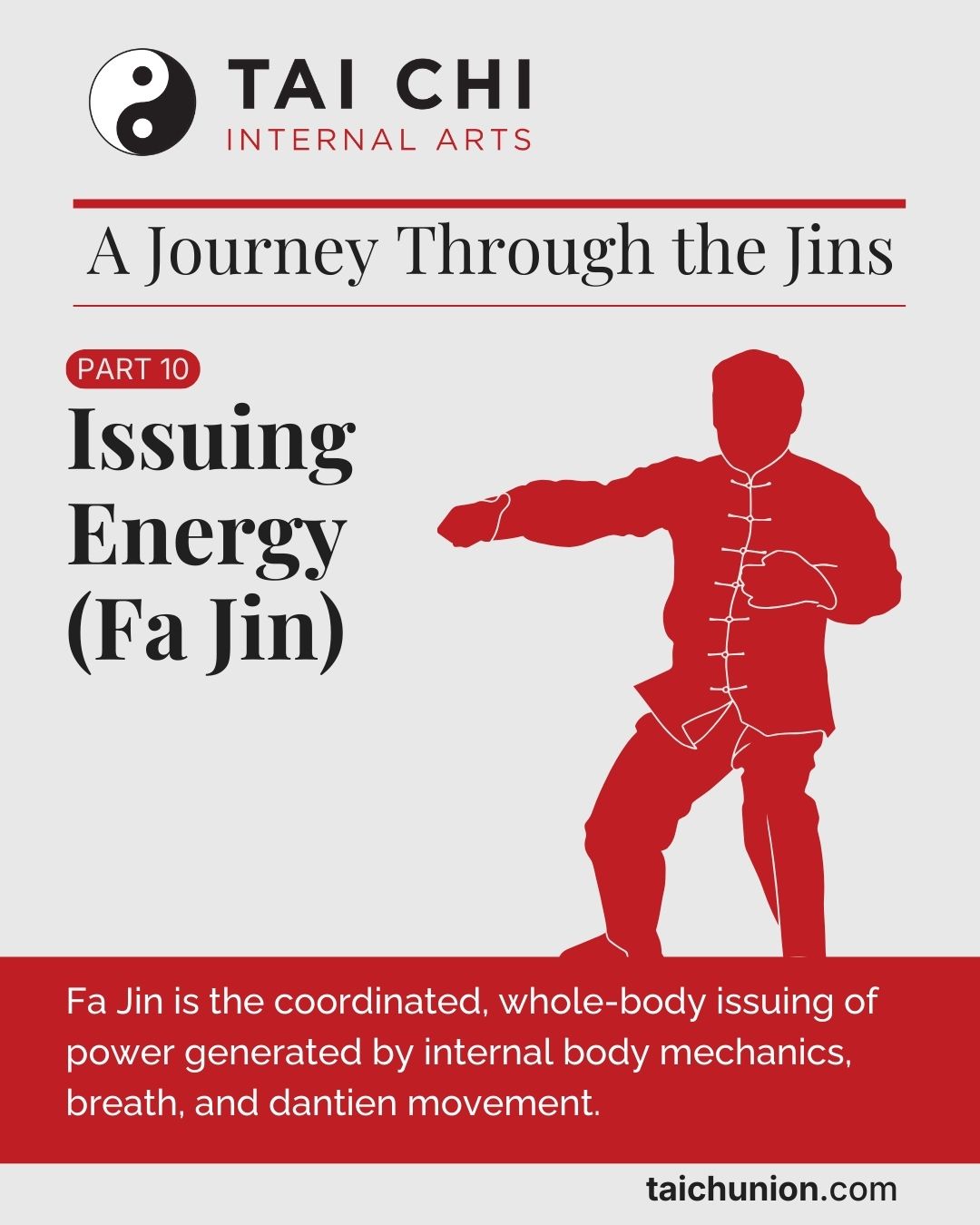
Of all the Jins we have talked about already, Fa Jin (issuing energy), especially when it is expressed in an explosive way, is perhaps the most visible and impressive to an onlooker. It’s that sudden blast of energy at the end of a movement that may shake the whole body in a spectacular manner that might remind you of what can happen if you have ever tried to bath the family dog. It can be expressed through your whole body (such as in the movement Hawk Spreads Wings, where energy is blasted outwards in both directions to repel two opponents simultaneously) or just through one part, such as a fist that barely moves at all.
A “one-inch punch” comes without warning from a seemingly stationary arm yet sends a shock wave through a punch bag or an assailant, though it is something you would never do to a training partner as it can damage internal organs. The Jins in play here might be known as inch Jin (Cun Jin) or cold Jin (Nang Jin) as the punch seemingly comes from a cold start, your body appearing to be still as the energy of the punch is generated by internal processes that are not obvious to an onlooker.
Fa Jin is not a difficult skill, once you know what it is, where it’s coming from and how to issue it from any part of your body that’s in touch with your opponent. It could be released at the end of a downwards or upwards push (An), a press (Ji), an elbow strike (Zhou), a shoulder stroke (Kao), a pluck (Cai), an inwards or outwards splitting action (Lie) or even straight from your torso, perhaps from your back or your abdomen, if someone is unwise enough to press against it with a straight arm.
From this, you might have gathered two important points:
Firstly, Fa Jin is not about just doing a movement more quickly and suddenly in the hope of making it hit harder and look more spectacular. That’s something called a percussive strike that relies on speed and strength to create an impact, which is not what we are talking about here. We are playing with physical forces in all the ways previously described but when we issue Fa jin we are not hitting with force, we are releasing energy and generating a shock wave. An example of this is the one-inch punch where, rather than being pulled back and then used to hit out against the body, the fist may already be pressed against the attacker’s body as the shock wave is released. Fa Jin can also be released at the end of a longer punch that may look like a percussive strike but has whole-body connectedness and is powered by shaking energy rather than a stiff, straight arm, however fast it’s moving.
Secondly, the mention of the abdomen may have suggested to you that the dantien is involved in this process, which should not be surprising now that you know how the feeling of rolling the lower abdomen, coordinated with your breathing, can inflate your imaginary balloon and generate your Peng Jin. When you “peng someone away” with your springy press, or lift them off their feet with your An Jin, it’s not normally in a slow, smooth manner (if you don’t want them to laugh at you), it’s the blast of Fa jin at the end of it that knocks them on their backside.
That said, Fa Jin is not something to be messed with without a good teacher to check that you’re doing it properly. There are several safety considerations to bear in mind if you want to practice it without doing yourself a mischief. Because of the explosive release of power involved, you can easily end up with a hernia, a prolapse, a back injury or even concussion if you just have a go at it without knowing what you are doing.
So here are a few safety tips to bear in mind.
- Roll your dantien. As you breathe out, imagine your lower abdomen as a ball that can roll down and under at the back, and upwards and inwards at the front, so that as your tailbone drops, your midriff pulls inwards, protecting your umbilicus. (This is also the basis for protecting your abdomen from incoming blows in so-called “iron shirt training” or nei gong). A gentle squeeze of the muscles underneath as the ball rolls forwards can help to protect your pelvic floor so that you don’t end up with a prolapsed bowel or uterus, or an embarrassing release of bodily contents, which could happen if you keep that area fully relaxed and let the force travel straight downwards instead of forwards and upwards. “Keep your Qi gates closed”, as the old masters advised.
- Let the energy go outwards from your body and not upwards into your head. Think of your brain as a soft ball floating in liquid inside the hard shell of your skull. It doesn’t like to be shaken about in there like a pea in a drum, which can happen if you let everything shake, including your head. If you have ever watched a dog shaking itself, it kind of rolls from side to side, starting from the neck down and, although it’s not the same as the Fa Jin we are talking about here, it’s interesting to note that, while all this goes on, its head is quite still.
- Don’t be over-enthusiastic about tucking your tail under as your dantien rolls, or you could end up with a very sore coccyx or even a back injury. It’s actually quite a subtle feeling, this rolling of the ball, and you can actually roll it sideways into an elbow or shoulder strike, for example, without very much happening physically at all.
- If possible, open your mouth when issuing your Fa Jin, otherwise the sudden burst of pressure as you breathe out explosively through your nose can damage the delicate membranes in your throat and nasal cavity and increase your risk of developing snoring or even sleep apnoea as the years go by.
- Don’t let your shaking Jin go all the way down into your legs and make your knees tremble like jelly. Quite apart from any potential damage to your wobbly knees, this procedure can destabilise you so that anything your torso does will be less effective. Keep a firm root and let your hips and legs be a stable foundation for the expansion of energy from your dantien outwards through your arms, shoulders, elbows, hands or fingers in whatever direction you intend it to go.
- Don’t overdo your Fa Jin training. Practicing occasionally to make sure you can do it is fine, but if you keep doing it every day or every time you do your form, you are more likely to end up with some kind of injury such as those listed above.
- If possible, find a good teacher if you are in any doubt at all, but don’t take advice from anyone advocating pushing your whole tummy out explosively (risking an umbilical hernia), shaking your head, or fully relaxing your undercarriage while issuing Fa Jin.
If all the above has not put you off internal martial arts completely by now, there is just one more type of Jin left to explore in this current series. We hope that your exploration of all the Jins we have discussed so far has increased your enjoyment of your chosen discipline. Do keep practicing but, most importantly, be safe as you enjoy the journey.