

Part 3 of 11 · Article Series
A Journey Through the Jins
This article is part of our 11-part series on the Jins in the Internal Arts.
You can start from the beginning or jump to any part using the links below.
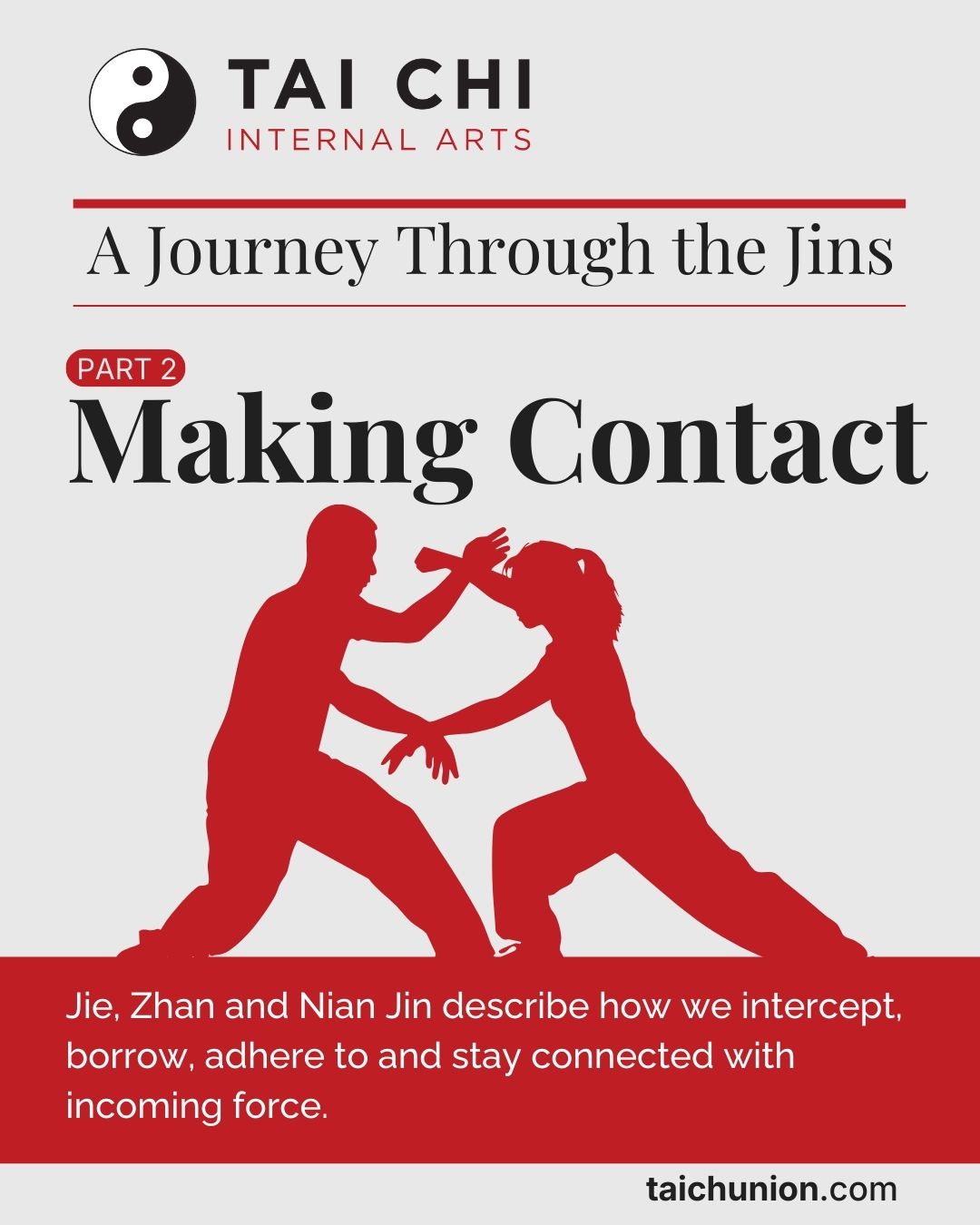
Hard blocks are not considered to be a useful strategy in Tai Chi. One of its first principles is ‘Never meet force with force.’ If you hit an incoming arm out of the way and then just stop there, or let go while thinking about what move to make next, your opponent has time to retaliate, and you have lost a valuable opportunity to sense and do a whole bunch of other useful things. So, instead, the idea is to intercept it softly and stick to it like glue wherever it goes.
Under normal circumstances, the words “stick” and “adhere” might seem to refer to exactly the same thing, with “adhere”, perhaps, seeming slightly more formal than the common word “stick”. However, when describing types of Jin, there are subtle differences because the words are translated from the Chinese concepts of Zhan and Nian, which have slightly different meanings, just as there might be a subtle difference between getting stuck to a wall covered in superglue, and touching a piece of fly paper that adheres to you so you can’t shake it off.
Either way, once any part of your body is in contact with your opponent, it’s worth sticking around as you immediately have access to information that you couldn’t otherwise know about, such as their intentions and any forces at play in the encounter.
Being able to stick to your opponent presupposes that you have managed to intercept them in the first place, and this is something that comes naturally from your inflated state of Peng Jin, which rises up to meet and connect with an incoming force and can even “borrow its energy” (Jie) in the process. Rather than intercept an opponent’s fist or arm with a hard block in an attempt to stop it in its tracks, it may be more helpful to get your head out of the way while your own arm or hand connects with the offending limb and follows it (Tzo), sensing its incoming velocity and perhaps applying just a little extra something to help it on its way, but in a new and unexpected direction.
It's all very well saying this as, using the power of our imagination, we visualise time slowing down like in The Matrix, allowing us to work out what’s happening bit by bit, but what we’re talking about here is quite an extreme situation that is likely to be over in less than a second if our reflexes are too slow. That’s why the training is all about repetition and practice until all of these Jins become programmed into us at an unconscious level where we don’t have to think about them anymore. The conscious brain is way too slow to even register things that are happening within fractions of a second, but we can learn about them, feel them as we practice them slowly in our forms, sensing hands exercises and applications of movements until they become second nature so that, in some situations, they can even occur before we have time to think at all.
In a conflict situation, having your arms raised to begin with in something like a strum the lute/ guitar/pipa position helps to reduce the amount of time required to ward off a blow, but a general feeling of inflatedness with your Peng Jin helps in the process of intercepting, borrowing, sticking and adhering to an opponent and allows you to use a thing called “listening energy” or “Ting Jin”, which we will be looking at next.