

Part 7 of 11 · Article Series
A Journey Through the Jins
This article is part of our 11-part series on the Jins in the Internal Arts.
You can start from the beginning or jump to any part using the links below.
“Push” is a deceptive word. To push against something implies resisting or trying to move something from a static position while overcoming its solid inertia. If someone is pushing against you and you try to push back, like bulls locking horns, it becomes a contest of sheer brute strength, which will be won by the strongest, largest or heaviest person.
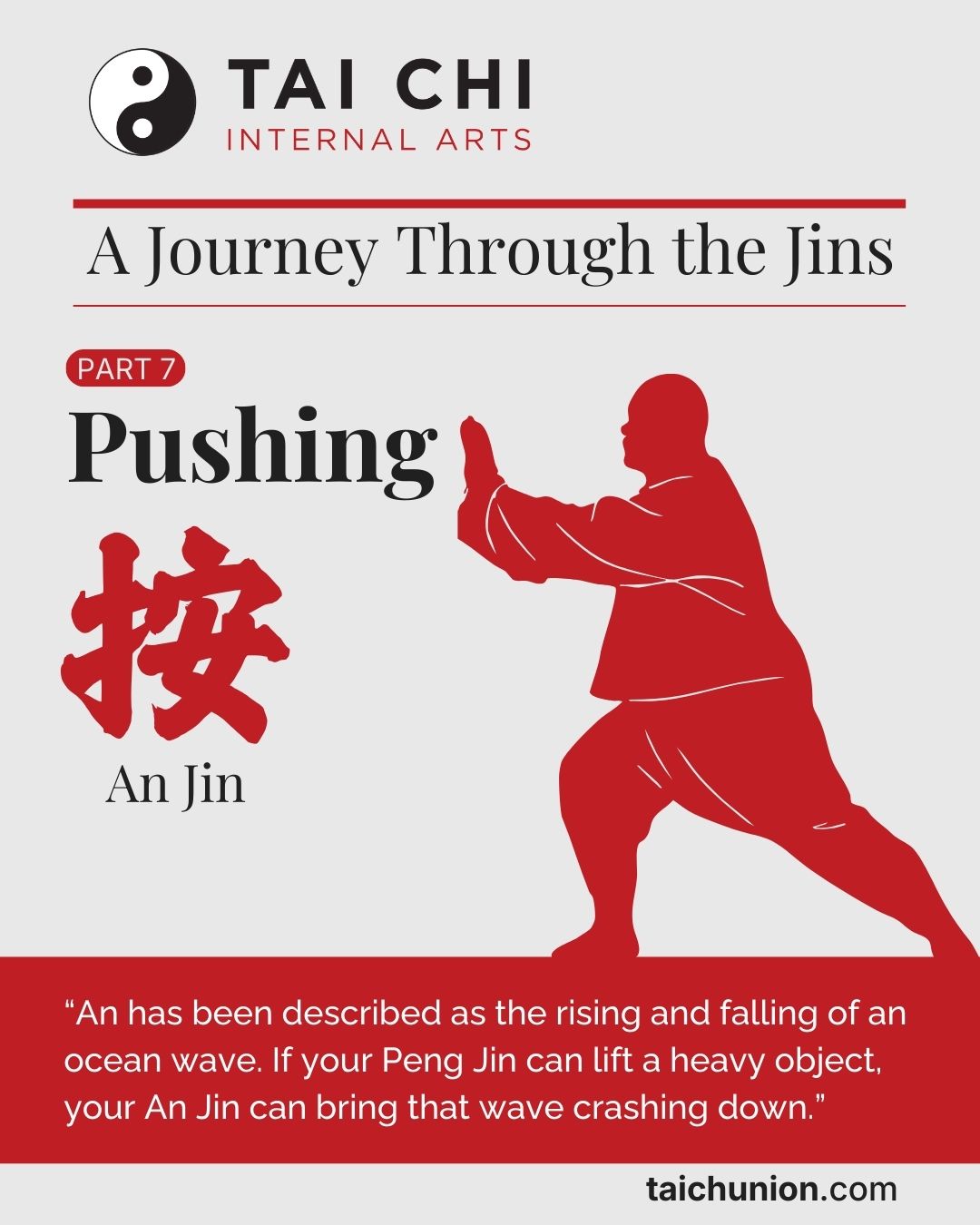
In contrast, the energy of An has been described as the rising and falling of an ocean wave. If your Peng Jin can lift a heavy object, your An Jin can bring that wave crashing down.
Again, we are playing with forces, in this case the incoming weight of your opponent. With your hands on their chest, as you feel their weight begin to press against you, you melt backwards and downwards and redirect it in a vertical circle. There is no moment of inertia to be overcome for a ball that is already rolling.
Expecting resistance, your opponent feels as if they are falling into a hole, at which point, their force comes back at them like a tidal wave which can either lift them off their feet or overwhelm them and drop them into the floor. Either way, it can destroy their root and unbalance them.
The circle comes from the rolling action of your lower abdomen (Dantien), and the downwards or upwards force generated depends on which way the ball is rolling and the point at which you issue your energy as a tangent off that circle. The circle generates the wave.
The action can be large and obvious as you sink away from them and bring your arms in and down around an invisible ball prior to issuing your energy from the circle to lift them off their feet, or it can be small and subtle. The ball still rolls within your dantien, but the circle expressed through your arms can be very small, repelling your opponent at long range rather than allowing them all the way in.
In extreme situations, An may be used as a percussive single or double palm strike, but in all other circumstances, such as push hands practice and competitions, it would only be used to redirect an already incoming force. If there is no incoming force to work with, you can issue a “dummy push” without any Fa Jin, to entice them (Yin Jin) into retaliating, thereby giving you a force to work with. This presupposes, of course, that they rise to your bait. In some famous stories of encounters between masters, they have touched hands and then simply bowed to each other and walked away, each having discovered enough from that one touch to conclude that they are equally matched in sensitivity and skills, so a contest would be pointless.
As with most types of Jin, An may be expressed in different ways and at different ranges, depending on the style you practice. In different styles, the dantien may be used in subtly different ways: the ‘ball’ may be obvious to an observer or almost imperceptible. The point is that, at a high level, the ball is always there.
An Jin can also be applied using one hand while the other is used to deflect and control, as in Brush Knee and Push. Even in what looks like a double-handed push, one hand may simply control the opponent as the other hand pushes, so the force is issued unequally to disorientate or unbalance them. It may also be applied to tip the opponent sideways by skewing its application upwards a little with one hand and downwards with the other as you push.
The least effective type of push is where you use your arms like pistons, bringing them in horizontally and getting them trapped against your body, hesitating, then struggling to shove them back out against a moment of inertia, even if that inertia just comes from your own stopping and starting and is not compounded by the incoming weight of your opponent. In contrast, anything coming off a circle is more powerful than a linear force from a standing start, as every discus thrower or shot-putter knows. So, in the internal martial arts, the study of underlying Jins becomes a whole new ball game.