

Part 9 of 11 · Article Series
A Journey Through the Jins
This article is part of our 11-part series on the Jins in the Internal Arts.
You can start from the beginning or jump to any part using the links below.
So far, the actions we have considered have mostly relied on the use of hands and arms to ward off, roll back, press, push, split and pluck, in order to intercept and generally mess up an opponent’s attack and either divert it or send it back at them. We have also stressed the importance of the whole body remaining stable and balanced as it absorbs, borrows and redirects incoming forces. Nowhere is this more apparent than in moves where you don’t use your hands at all because the response comes from your entire body without your hands touching the opponent.
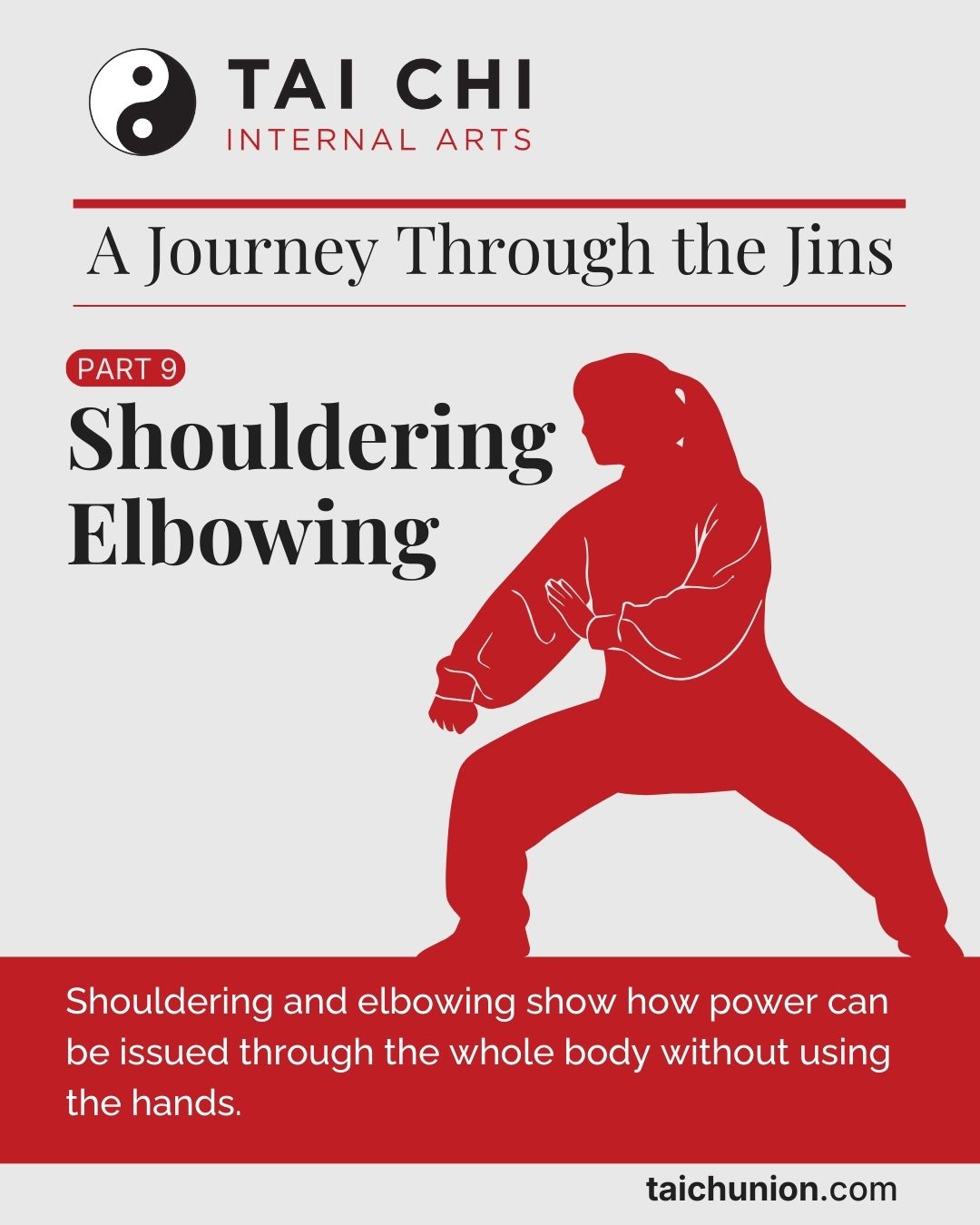
Elbowing (Zhou)
In an actual fight (not in competitions, where it’s not normally allowed), you are free to use your elbows. An elbow strike can be directed sideways, forwards, backwards, upwards or downwards, and can rapidly transform from one to the other. This is especially obvious in the triple palm changes of bagua involving elbowing to each side as you change direction. In a fight, you can aim your elbows in various directions, but you would need to be stable and rooted and feel the movement coming from your whole body rather than just your arm.
It is not recommended to try this out with a partner unless they are wearing fully protective body armour. It’s better to practice on a training dummy or punch bag, if you have access to one, (being careful not to damage your own joints in the process) but you can still practice them without any equipment. Just take a deep, stable stance and aim your dantien ball in any direction to drive your energy into an imaginary opponent through the point of your elbow.
Keep your shoulder pressed down, even as your elbow rises in side-to-side strikes, otherwise some of your energy will get stuck in your shoulder and your strike will be less effective, perhaps even damaging your own shoulder in the process. Another type of elbow strike is where you fold in your arm and lift your elbow up in front of you under an imaginary assailant’s ribs or chin. You can also aim it backwards into the gut or solar plexus of the imaginary guy behind you.
Shouldering or bumping (Kao)
At very close range where you don’t even have space for an elbow strike, if you can turn so that your upright body is sideways on your attacker, you may have the opportunity to use a shoulder press (Kao Jin) by transferring your weight from one leg to the other so that the weight of your whole body surges against the opponent. This may create enough space for you to apply an elbow strike, followed by a back fist strike to the groin or face.
You can also use the shoulder to ‘bump’ them at an angle as you turn your waist inwards towards them, and you can actually hit them with the upper part of your back. Perhaps less obviously, you can use Kao energy in moves such as Part the Wild Horse’s Mane and Diagonal Flying as you control their arm with one hand and pull them in against your body to lift, turn or throw them.
In the various types of Jin we have discussed so far, having been through the processes of intercepting, adhering, following and interpreting the situation, we have responded by either neutralising their incoming forces in various ways, such as moving backwards and turning to dissolve their energy and guide them into emptiness, or by using their incoming momentum to propel them away with a press or push of various varieties. The latter category follows up any absorbing and neutralising going on by issuing our own energy into and through the attacker. Therefore, issuing Jin (Fa Jin) is what we will be discussing next.