

Part 2 of 11 · Article Series
A Journey Through the Jins
This article is part of our 11-part series on the Jins in the Internal Arts.
You can start from the beginning or jump to any part using the links below.
From your very first lesson in Tai Chi or related internal arts, you will have been encouraged to relax, and with good reason. You can’t let your Qi flow through your body and limbs, either to improve your health or to hold your own against an opponent, if you are as stiff as a stick, so muscular tension is out.
Having said that, an overly relaxed stance in a fight is about as useful as a punctured balloon. It’s impossible to go straight from a completely loose and floppy state to actually doing something useful to defend yourself without first waking up your body in a manner equivalent to inflating your balloon.
If you want to divert an incoming assailant into a less threatening trajectory, or bump them off you, fling them sideways or uproot them with a blast of your Fa Jin explosive power (as an alternative to just standing there and allowing them to hit you or knock you over) you will find all of these strategies easier to accomplish if you have trained your body to adopt the kind of springy resilience of a rubber ball that can either spin on its vertical axis or bounce things away from you.
The Tai Chi Classics describe Peng Jin as a wave that lifts a boat without effort. But, if your opponent is the floating boat, where does the wave come from?
To answer this question, you might try simply lifting one hand in front of you. You can experiment with this by starting off with your arm hanging down, loose and floppy and then noticing various ways of getting your hand to rise forwards and upwards, level with your shoulder. One method might be to stiffen everything up and use your arm muscles and shoulder in a way that would look good in a robotic dance. Another way would be to let your arm have all the structural integrity of a limp lettuce leaf and just bend your elbow while letting your hand dangle in front of your shoulder. As a third alternative, you could imagine standing in a swimming pool with the water up to your shoulders, then just relax and let all your weight sink down as the water floats your hand up to the surface. This third alternative would be a great way to introduce yourself to the feeling of Peng Jin.
Another way would be to imagine holding a large balloon in your arms. As you breathe in and out, imagine the balloon inflating and deflating. It might seem logical to inflate it as the air fills your chest, but now try it the other way around, so that breathing out inflates the balloon, as if air from your back is somehow being breathed into the balloon through your lower abdomen (dantien).
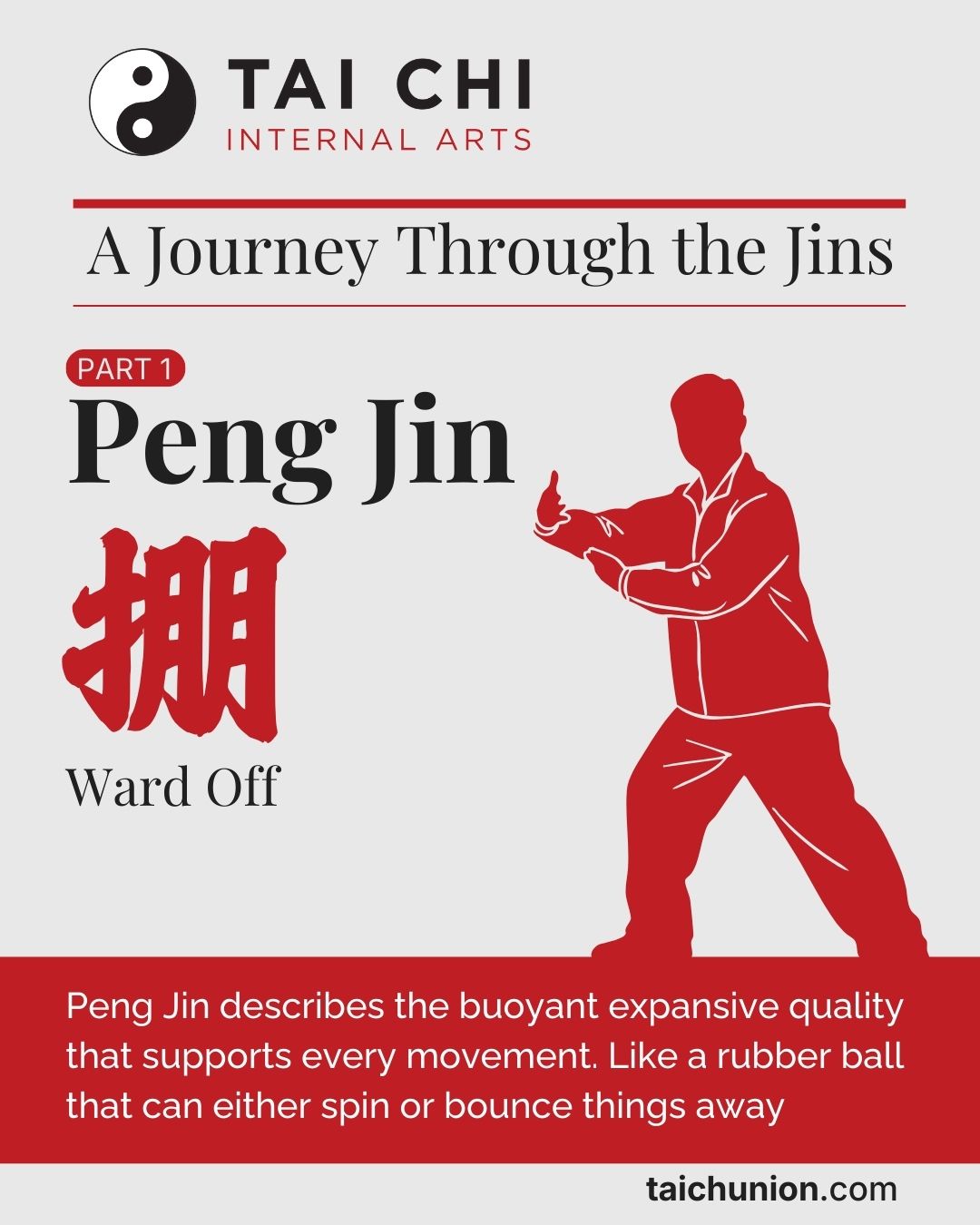
To explore this with a partner, you might like to try standing in an upright, forward stance with your feet shoulder-width apart and your gaze level and adopt a ward-off position, with your arm in front of your chest. Ask your partner to place their hand lightly on your forearm.
Start by going extremely soft and floppy and ask them to notice how that feels. Clearly, if they pushed hard on this it would just collapse your arm against your chest, and you could be knocked over. To stay on your feet, you would have to rely on the ability of your body to absorb their force into the ground (rooting) or use your waist to spin it away from you, otherwise you would find yourself unbalanced or worse. In other words, you would have to rely on Peng Jin throughout your whole body, rather than your arm, to hold them off.
Next make your arm as stiff and rigid as possible and ask them how that feels now, but make sure they don’t press too hard if you don’t want to end up with a dislocated shoulder!
Finally, start with your very floppy ward off and invite your partner to feel the difference as you gradually fill your body with Peng Jin.
To do this, breathe into your back, then, as you breathe out, drop your tailbone and imagine an invisible ball with its centre inside your lower abdomen, rolling down at the back, underneath you and upwards at the front, and allow it to inflate beyond the surface of your skin like a huge balloon that is pushing upwards against that hand. As your upper arm drops, your wrist naturally rises, but keep it still, rather than letting it lift very far, and ask your partner if they can feel any difference. Then ask them to start to push against your arm with gradually increasing force.
Keeping your shoulder and elbow dropped, let your arm simply relax into its strong and stable circular structure around the surface of the imaginary balloon. You should find that, as you feel the push come in, you can let your weight sink into your legs, absorb the force and drop it into the ground.
It will probably feel to your partner that they are pushing on the floor and if you were to choose to suddenly inflate your balloon just a little bit more, it would be as if the floor came up and hit them. Obviously, you wouldn’t want to do that to your partner, especially if their arm is locked out as they push, since they don’t want a dislocated shoulder any more than you do. The purpose this exercise is simply to allow them to feel the build-up of Peng Jin in your arm and the stability of the structure of your body in absorbing their push. It’s also an opportunity for you to feel that process of inflation and to experience the resulting stability, power and resilience within your own body.
The next step would be to swap roles with your partner so that you can feel the difference between a floppy opponent, a stiff opponent or a relaxed yet springy opponent who is priming themselves with Peng Jin ready to Peng you away or blast you with their Fa Jin.
With regular practice, you can notice your Peng Jin in your forms and push hands or whatever else you are doing, which sets the stage ready for you to experience the many other types of Jin we are about to explore.