
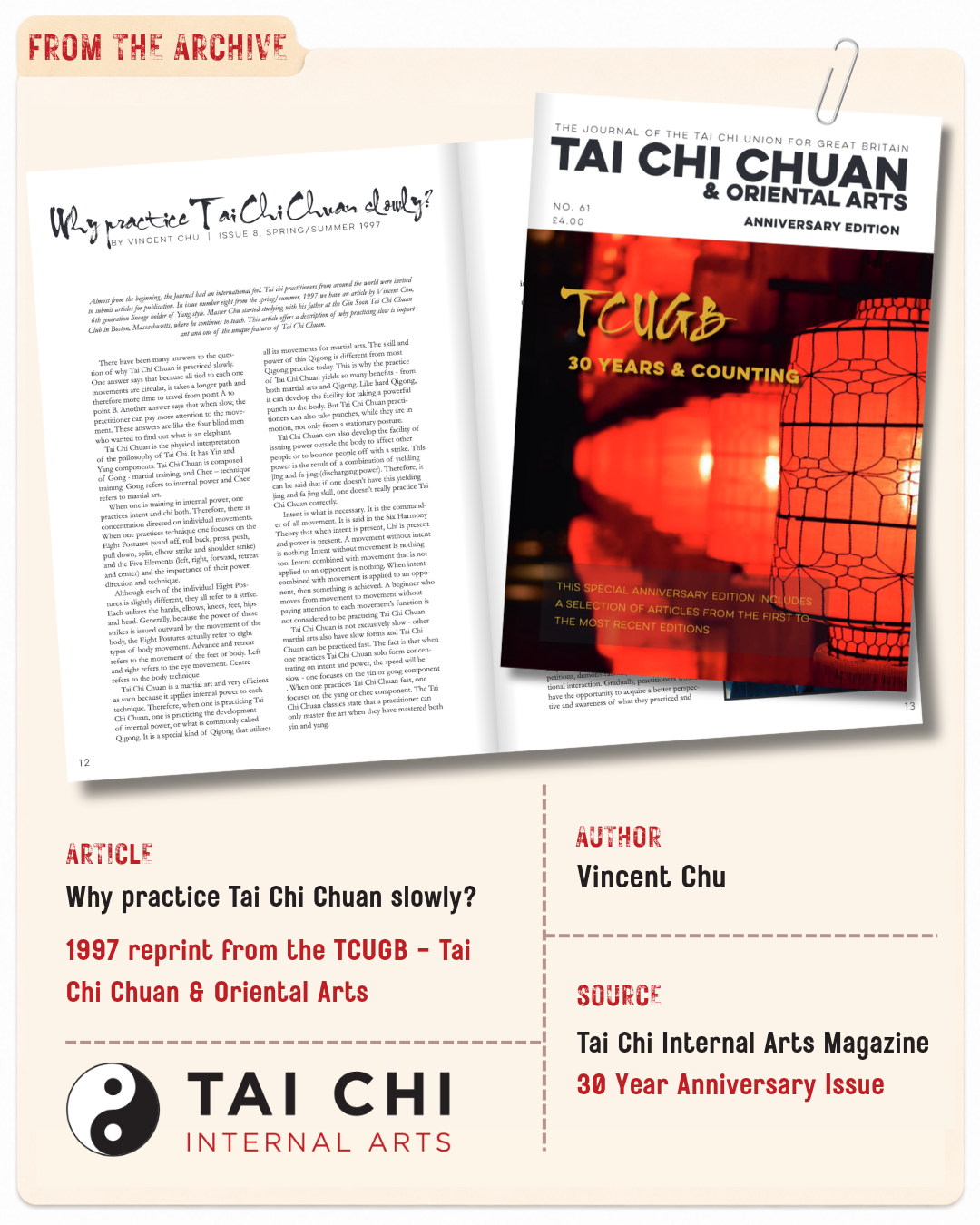
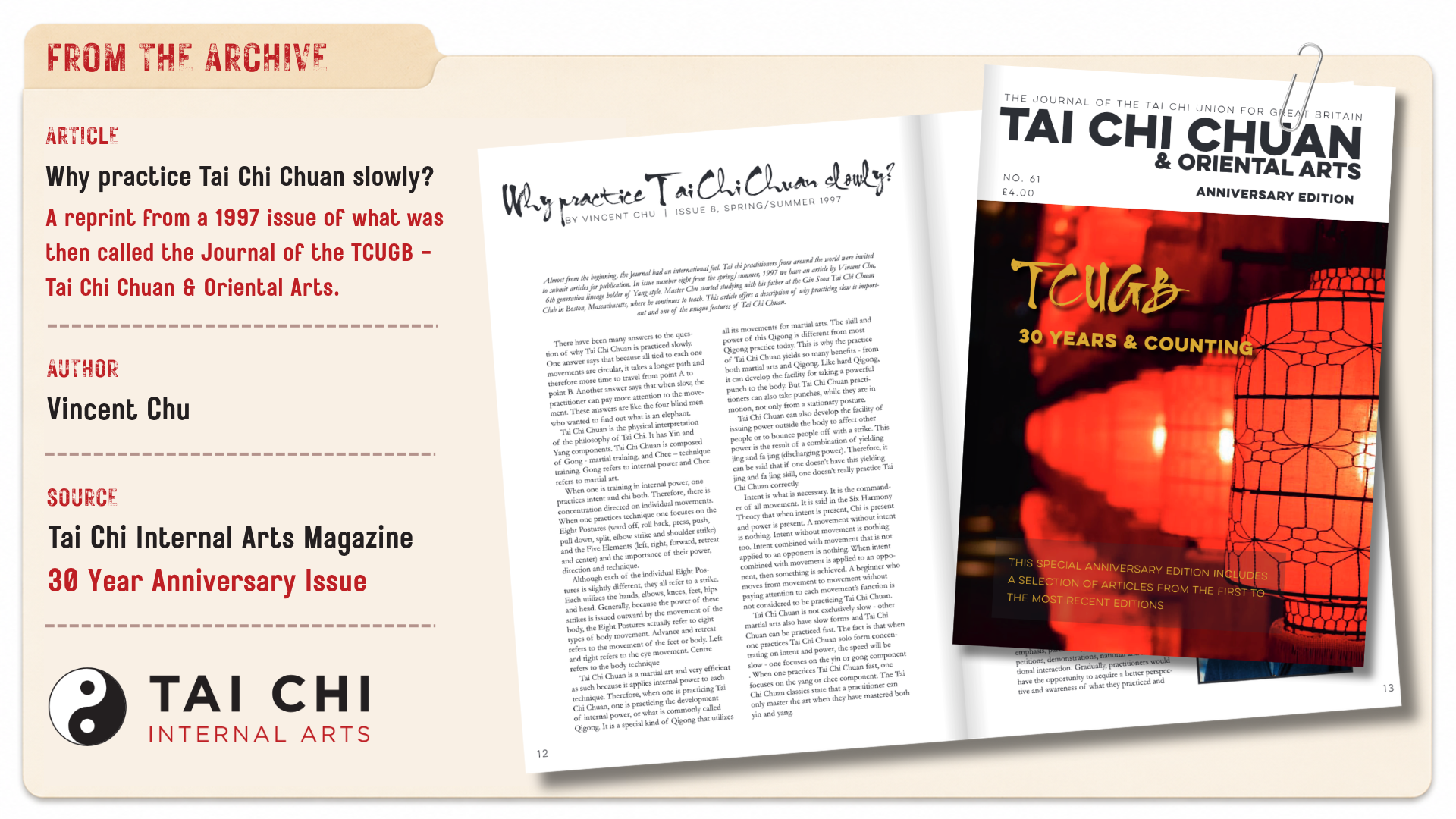
This article by Vincent Chu is a reprint from a 1997 issue of what was then called the Journal of the TCUGB - Tai Chi Chaun & Oriental Arts. The Yang lineage master discusses why Tai Chi Chuan can be practised both slowly and fast. In the course of this brief article, fundamental principles of Tai Chi are revisited and interpreted by Master Chu.
We are sharing this as part of our From the TCIA Magazine Archive series, with the article carefully condensed and presented in an easy-to-read format for everyone to enjoy.
The original article, as published, remains accessible in the Members’ Area of our website.
ISSUE 61 – Reprint from 1997
30th Year Anniversary (P12)
Author: Vincent Chu
Why practice Tai Chi Chuan slowly?
There have been many answers to the question of why Tai Chi Chuan is practiced slowly.
One explanation is that Tai Chi Chuan movements are circular, taking a longer path and therefore more time to travel from point A to point B.
Another explanation is that practising slowly allows the practitioner to pay closer attention to each movement.
The Philosophy of Tai Chi Chuan
Tai Chi Chuan is based on the philosophy of Yin and Yang, bringing together two important elements: Gong, which focuses on developing internal power, and Chi, which focuses on martial arts techniques.
When practising Gong, students develop intent and chi (energy), learning to focus on each movement. When practising Chi, they work on the Eight Postures and Five Elements, understanding how to use movement, direction and power effectively.
Enjoy this article? There's plenty more to discover.
Explore decades of articles and insights from across the internal arts in the Tai Chi & Internal Arts Union magazine and archive.
EXPLORE MEMBER BENEFITS
Tai Chi Chuan, Internal Power and Qigong
Tai Chi Chuan is about much more than moving slowly and smoothly. Behind each movement is the development of strength, energy and control. These are closely connected to something known as internal power, or Qigong.
Tai Chi Chuan is a martial art that uses internal power in every movement. Practising it helps develop this power, often known as Qigong.
Unlike many other forms of Qigong, Tai Chi Chuan combines energy development with martial arts techniques. This brings together the benefits of both practices, helping to develop strength, control and the ability to use power effectively.
An important part of Tai Chi Chuan is learning to yield (give way and redirect force) and fa jing (releasing power). Together, these skills allow practitioners to absorb and redirect force, as well as generate power through their movements.
The Importance of Intent
An important part of the practice is intent – the purpose and focus behind each movement. Intent guides the body. Without it, a movement has little meaning. Practitioners need to understand not only how to move, but also why each movement is performed and how it would be used in a martial arts situation.
Although Tai Chi Chuan is well known for its slow movements, it is not exclusively practised slowly. It can also be performed quickly. Slow practice focuses more on Yin and Gong, developing intent and internal power, while faster practice focuses more on Yang and Chi, developing martial arts technique.
As the Tai Chi Chuan classics explain, true mastery comes from understanding and developing both Yin and Yang.
Teach internal arts? Get recognised.
Show students that your teaching has been independently assessed by the Tai Chi Internal Arts Union.
- Accredited Instructor status
- Instructor profile
- Professional support