
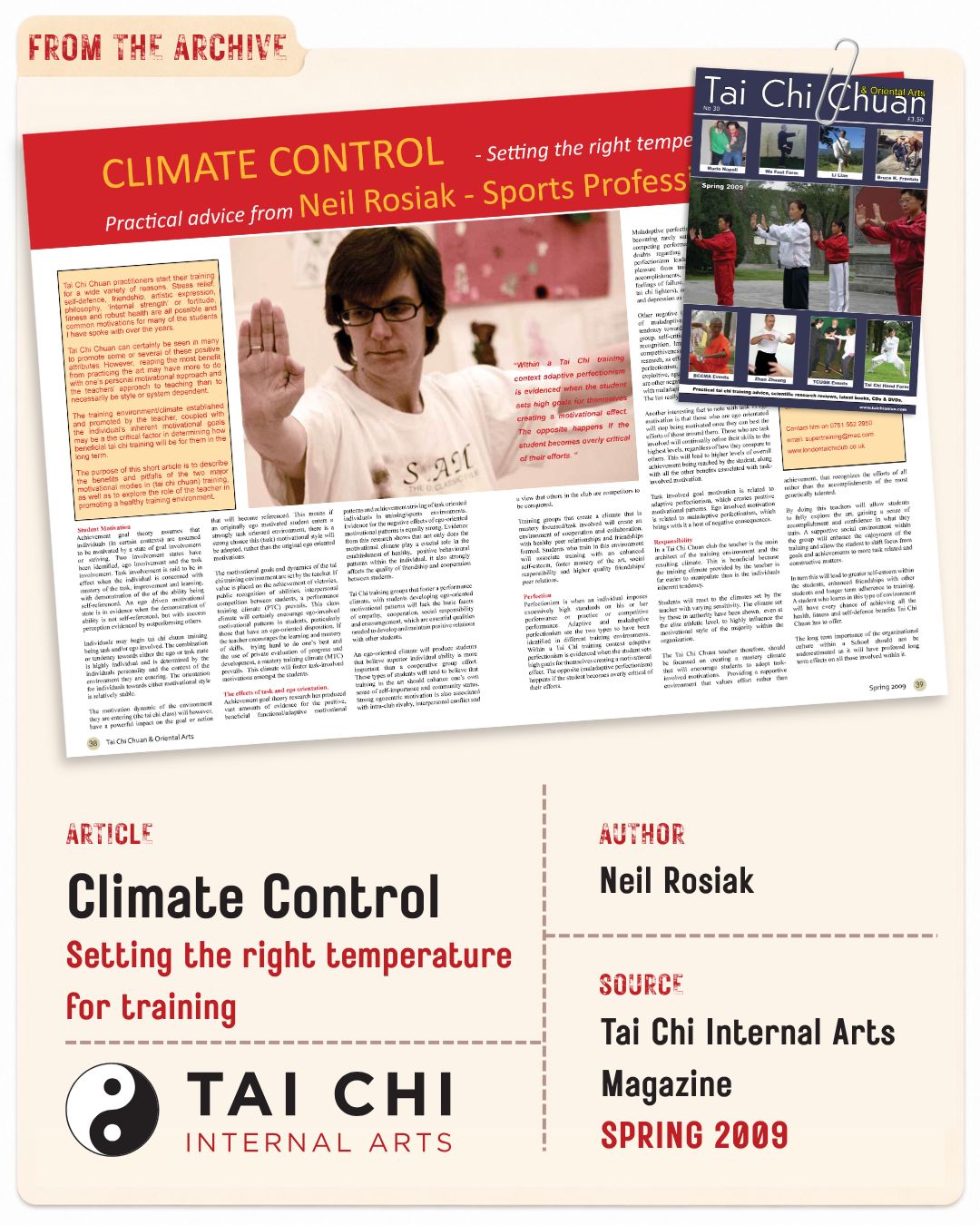
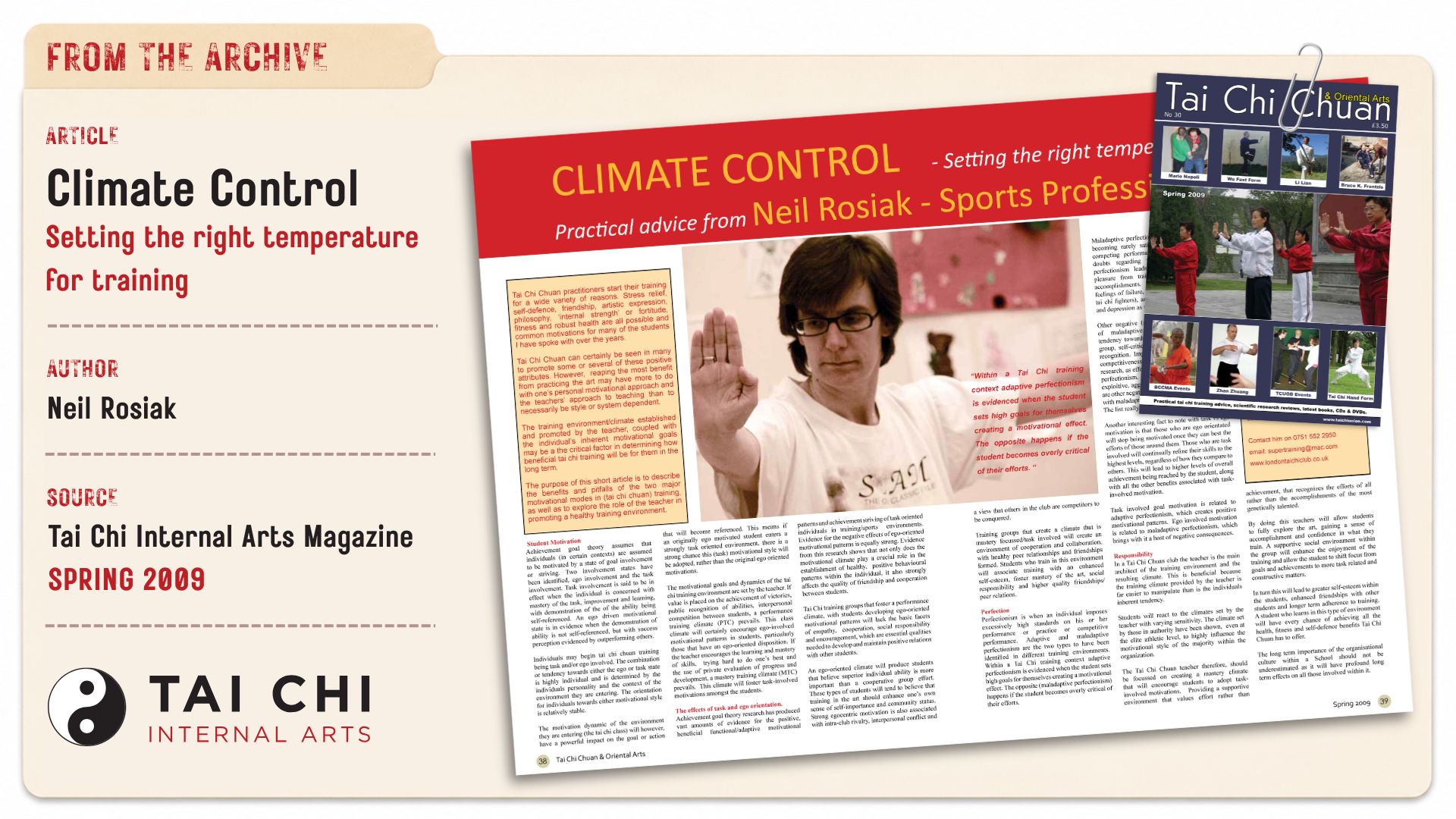
This article was first published as "Climate Control – setting the right temperature for training " in the Tai Chi Internal Arts Union issue 30 published in Spring 2009. It explores how the atmosphere created by a teacher can influence motivation, enjoyment and long-term progress in Tai Chi and the internal arts. While the research has continued to develop, the core ideas remain as relevant today as when the article first appeared.
We are sharing it here as part of our From the TCIA Magazine Archive series. The original text is presented in full, exactly as it appeared, to preserve the author’s insights.
Tai Chi Chuan practitioners start their training for a wide variety of reasons. Stress relief, self-defence, friendship, artistic expression, philosophy, ‘internal strength’ or fortitude, fitness and robust health are all possible and common motivations for many of the students I have spoken with over the years.
Tai Chi Chuan can certainly be seen in many to promote some or several of these positive attributes. However, reaping the most benefit from practicing the art may have more to do with one’s personal motivational approach and the teachers’ approach to teaching than to necessarily be style or system dependent.
The training environment or climate established and promoted by the teacher, coupled with the individual’s inherent motivational goals may be the critical factor in determining how beneficial tai chi training will be for them in the long term.
The purpose of this short article is to describe the benefits and pitfalls of the two major motivational modes in internal arts training, as well as to explore the role of the teacher in promoting a healthy training environment.
Student Motivation
Achievement goal theory assumes that individuals in certain contexts are assumed to be motivated by a state of goal involvement or striving. Two involvement states have been identified, ego involvement and task involvement. Task involvement is said to be in effect when the individual is concerned with mastery of the task, improvement and learning, with demonstration of the ability being self-referenced. An ego driven motivational state is in evidence when the demonstration of ability is not self-referenced, but with success perception evidenced by outperforming others.
Individuals may begin internal arts training being task and/or ego involved. The combination or tendency towards either the ego or task state is highly individual and is determined by the individuals personality and the context of the environment they are entering. The orientation for individuals towards either motivational style is relatively stable.
The motivation dynamic of the training environment they are entering will however, have a powerful impact on the goal or action that will become referenced. This means if an originally ego motivated student enters a strongly task oriented environment, there is a strong chance this task motivational style will be adopted, rather than the original ego oriented motivations.
The motivational goals and dynamics of the tai chi training environment are set by the teacher. If value is placed on the achievement of victories, public recognition of abilities, interpersonal competition between students, a performance training climate (PTC) prevails. This class climate will certainly encourage ego-involved motivational patterns in students, particularly those that have an ego-oriented disposition. If the teacher encourages the learning and mastery of skills, trying hard to do one’s best and the use of private evaluation of progress and development, a mastery training climate (MTC) prevails. This climate will foster task-involved motivations amongst the students.
The effects of task and ego orientation
Achievement goal theory research has produced vast amounts of evidence for the positive, beneficial functional/adaptive motivational patterns and achievement striving of task oriented individuals in training and sports environments. Evidence for the negative effects of ego-oriented motivational patterns is equally strong. Evidence from this research shows that not only does the motivational climate play a crucial role in the establishment of healthy, positive behavioural patterns within the individual, it also strongly affects the quality of friendship and cooperation between students.
Internal arts training groups that foster a performance climate, with students developing ego-oriented motivational patterns will lack the basic facets of empathy, cooperation, social responsibility and encouragement, which are essential qualities needed to develop and maintain positive relations with other students.
An ego-oriented climate will produce students that believe superior individual ability is more important than a cooperative group effort. These types of students will tend to believe that training in the art should enhance one’s own sense of self-importance and community status. Strong egocentric motivation is also associated with intra-club rivalry, interpersonal conflict and a view that others in the club are competitors to be conquered.
Training groups that create a climate that is mastery focused or task involved will create an environment of cooperation and collaboration, with healthy peer relationships and friendships formed. Students who train in this environment will associate training with an enhanced self-esteem, foster mastery of the art, social responsibility and higher quality friendships and peer relations.
Perfection
Perfectionism is when an individual imposes excessively high standards on his or her performance or practice or competitive performance. Adaptive and maladaptive perfectionism are the two types to have been identified in different training environments. Within an internal arts training context adaptive perfectionism is evidenced when the student sets high goals for themselves creating a motivational effect. The opposite (maladaptive perfectionism) happens if the student becomes overly critical of their efforts.
Maladaptive perfectionism leads to individuals becoming rarely satisfied with their training or competing performance, leading to continual doubts regarding training. Maladaptive perfectionism leads to an inability to gain pleasure from training and training related accomplishments. Eventually this can lead to feelings of failure, pre-competitive anxiety, anger, shame, low self-esteem and depression as well as burn-out.
Other negative (and well researched) aspects of maladaptive perfectionism include a tendency towards the betrayal of others in the group, self-criticism and feelings of a lack of recognition. Impatience, irritability, anger and competitiveness have also been reported in research, as effects of ego-involved maladaptive perfectionism. Authoritarianism, being exploitive, aggression and excessive dominance are other negative traits that have been associated with maladaptive perfectionism in the long term. The list really does goes on...
Another interesting fact to note with task vs ego motivation is that those who are ego orientated will stop being motivated once they can best the efforts of those around them. Those who are task involved will continually refine their skills to the highest levels, regardless of how they compare to others. This will lead to higher levels of overall achievement being reached by the student, along with all the other benefits associated with task involved motivation.
Task involved goal motivation is related to adaptive perfectionism, which creates positive motivational patterns. Ego involved motivation is related to maladaptive perfectionism, which brings with it a host of negative consequences.
Responsibility
In an internal arts class the teacher is the main architect of the training environment and the resulting climate. This is beneficial because the training climate provided by the teacher is far easier to manipulate than is the individuals inherent tendency.
Students will react to the climates set by the teacher with varying sensitivity. The climate set by those in authority have been shown, even at the elite athletic level, to highly influence the motivational style of the majority within the organization.
The teacher therefore, should be focused on creating a mastery climate that will encourage students to adopt task involved motivations. Providing a supportive environment that values effort rather than achievement, that recognizes the efforts of all rather than the accomplishments of the most genetically talented.
By doing this, teachers will allow students to fully explore the art, gaining a sense of accomplishment and confidence in what they train. A supportive social environment within the group will enhance the enjoyment of the training and allow the student to shift focus from goals and achievements to more task related and constructive matters.
In turn this will lead to greater self-esteem within the students, enhanced friendships with other students and longer-term adherence to training. A student who learns in this type of environment will have every chance of achieving all the health, fitness and self-defence benefits the internal arts have to offer.
The long term importance of the organisational culture within a School should not be underestimated as it will have a profound long term effects on all those involved within it.