
From Issue 74 of the Tai Chi Internal Arts magazine
Originally published as Showcasing Tai Chi Traditions by Ken Symon.
The magazine is included with membership and features articles, interviews, practical guidance, event coverage, perspectives and more from across the Tai Chi and internal arts community.
.
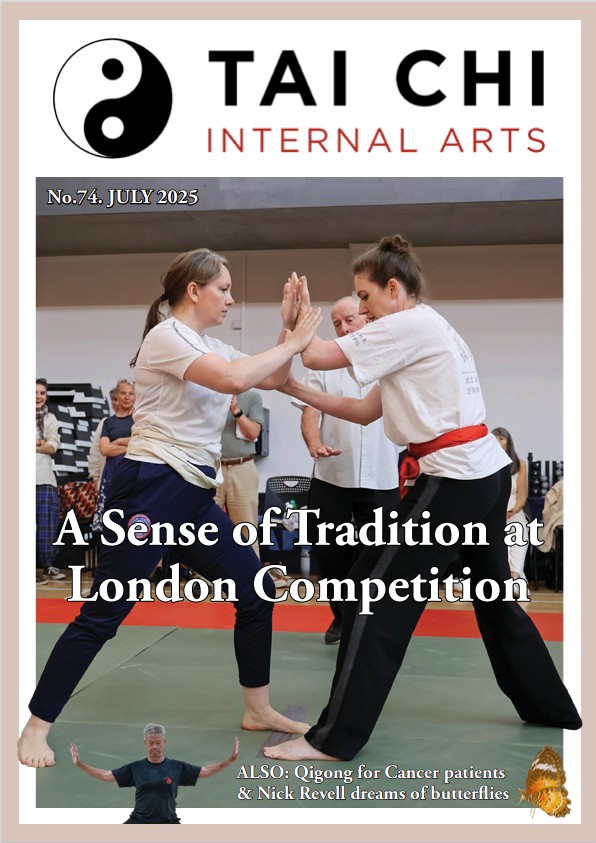
The London Open Competition for Traditional Tai Chi Chuan is held in a vast gym area at the Clissold Leisure Centre in Stoke Newington in the Hackney Borough in London.
The setting of the area, which is overseen by a café complete with large viewing window, means that it provides the opportunity for a great showcase for the competitive side of the art. The centre staff were helpful and the café offers tasty wholefoods, ideal for a break for competitors and a chance to have a seat and get a bird’s eye view of the competition.
There were 58 entrants in the 2025 competition with the event also being attended by double that again in coaches, supporters and friends and family. While still an impressive showing for the art it is markedly down on some previous years. The competition is organised by a formidable team from Wu’s Tai Chi Chuan Academy in London led by Traditional Wu Family’s European head Gary Wragg. Gary said that one factor in the disappointing numbers competing was the international situation with tariff wars and other
issues hitting people’s pockets.
He said: 'It has changed a lot of people’s appetite for travelling. But many people I’ve spoken to today having seen what’s happening here; it’s an inspiration for them to come next time.'
He stressed the benefits of competing too: 'The thing is if you do compete, you see where you’re at. It’s not really about winning or losing – it’s good to win, but it doesn’t matter if you lose. You always get something from it. Always. And you can improve on it.' Nicole Halliday, a key member of the organising team, said that at its height there had been around 170 competitors but since Covid, the event had not returned to that level.
She said: 'We’ve been doing it for 15 years. It had got progressively bigger across the other UK events - and also European championships, run every two years - unfortunately things just started to decline. Some smaller competitions came to an end; the British Open, one of the largest UK events, unfortunately is no longer running. Generally it seems as though the appetite and opportunity for these things is just not what it was. There are lots of questions.
'We’ve created an opportunity and there’s just not been as much interest but maybe things will improve in time. There have been cost of living issues for people; we had a lot of contingents from across Europe and so I think circumstances will be different for them these days; travel costs, hotel costs, just circumstances around Europe at the moment. We shall see. I’m proud of what we’ve done and there’s been a good energy in the room so that’s a success but I am concerned about the longevity of the event.'
Physically Intense
The competition tested a whole range of categories of Tai Chi. The events included individual hand forms, group forms and weapons including sword, sabre, spear and fan. There were also Fixed Feet and Moving Step Push Hands.
Shezad Dawood, who was mainly refereeing the Fixed Feet Push Hands, has been refereeing for about a decade. He said: 'For readers who haven’t done competition, I remember very early in my years I didn’t see Tai Chi as about competition either, but remember Sifu Gary Wragg saying "it’s not about winning and losing: it’s about testing what you’ve learned with other practitioners who you are not training with on a regular basis." That was the seed that got me going and it became a way just to improve my Tai Chi.
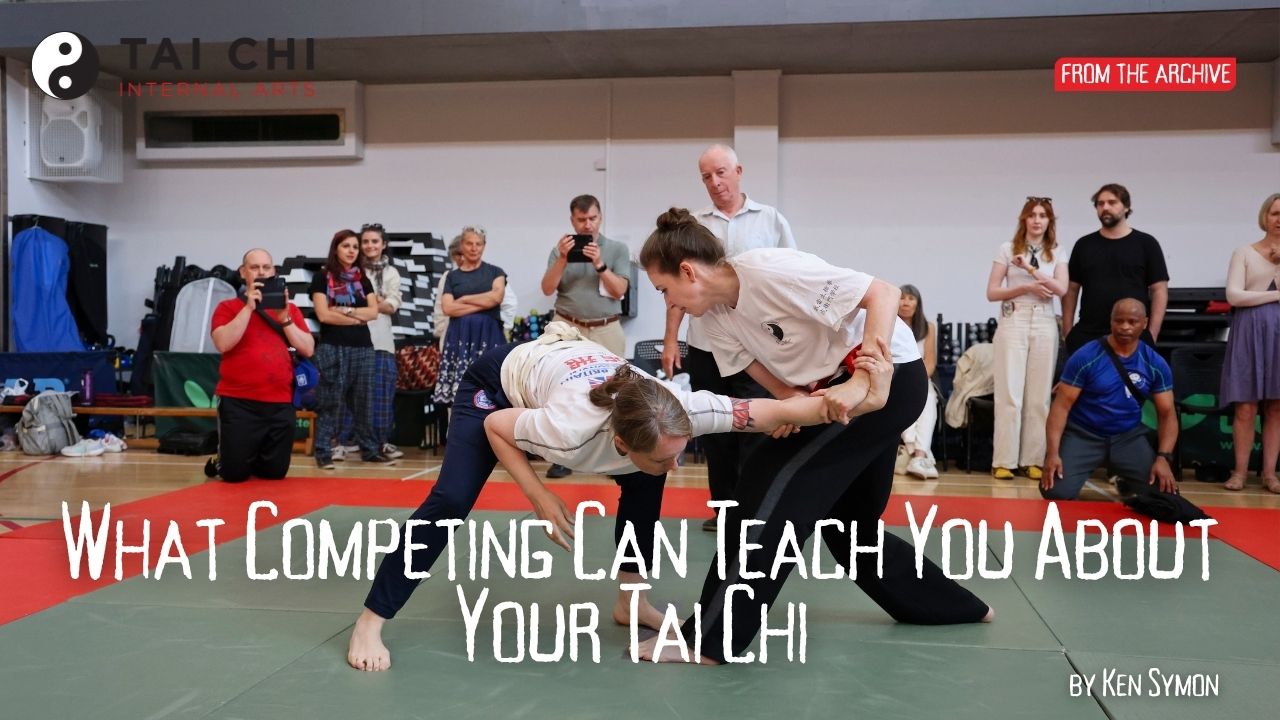
'He explained the rules: 'In Fixed Feet Push Hands you’ve got a set of mats with a line in the middle, to put it simply, and you start both right foot, right arm forward, right foot has to cross the line and the key thing is not to raise either of your heels.
'You can apply all of the standard Tai Chi techniques that you are learning in your respective classes: peng, lu, ji and an. What are you not allowed to do? You’re not allowed to attack the head, the neck, go round the back, not allowed to attack the legs. You’re not allowed to punch; no biting, kicking, spitting – it’s actually in the rules believe it or not. I haven’t seen much of that. Pulling of clothes is not allowed, you do get that. But the idea is to uproot your opponent using Tai Chi techniques.
'Basically what happens is that if either heel comes up you lose a point, if your opponent manages to make you skip as part of a continuous technique i.e. both your feet come off the ground in that continuous action - rather than one comes up and then the other goes up a few seconds later – then that’s two points. If any part of your body hits the floor, it’s four points – so your hands, your body, your knees - make contact with the floor, it’s four points against you.
'The whole bout is two minutes, obviously one minute on either leg, you start on the right foot and swap halfway through. If each competitor has a stronger side, then it evens out. Two minutes sounds very quick but it’s not because the clock is stopped and started when the ref says go or stop.
'It’s actually physically very intense, people are sweating. One of the hardest things – because I used to compete for many years before I switched to reffing the bouts – is keeping your chi down. In that very intense environment, that’s a very good test of your Tai Chi because it’s very stressful and can sometimes get quite physical.
'If you can keep your chi down and still be applying techniques, it really shows. You can see a good competitor a mile off. The key is rootedness, if somebody’s root is really going down through their feet down into the ground, you can see it and it’s very hard to dislodge them.'
I point out that in one bout, Shezad had said to one of the competitors that he was right on the edge. What was that about?
'You’re not allowed to put an arm around the back but obviously sometimes in a technique the arm goes under the armpit, you’re applying a lock and it’s right on the edge but I will - if I see somebody creeping into the danger zone where I might have to put a foul against them - I will give them a warning.
'If you do any of the breaches that I mentioned earlier, you will get a point against you if it’s not intentional, and two points if it’s a clear foul. I will often give a warning first. I like to create a good energy on my desk, so I will get everybody from a weight category together first to check that they are clear on the rules. I will also try and pre-empt a foul so if I see somebody heading in that direction, I shall caution them, so that they know they were close, because I think that creates a better energy than just penalising people after the fact.
'Each year it’s different, we’ve had quite a few newbies today. There were four competitors that I spoke to that it was their first time competing. It’s nice to encourage them so they come back and keep testing their skills.
'As you said there are a lot of people who don’t take their Tai Chi into competition so I think when people do, it’s quite nerve wracking. I still remember my first competition. I don’t remember tons in between but my first one I remember doing moving step and flying backwards through the air, very soon into my first bout. It stays with you.
'In the first one, it’s very hard to keep your chi down; you’ve never been in this competitive forum. You need to do it, probably a couple of times and then you’re starting to learn. You learn how to keep your chi down and how to keep your concentration and focus. You can see with experienced competitors that they are immediately in the zone.
'You can see with people who have been doing it a long time they don’t really engage before their bouts. I remember back in the day Sifu Gary [Wragg] would say to me: "Meditate, practise, stay in your own…don’t interact, don’t fritter your energy away. I would sometime come, read a book, find my corner and be very much inward before I was called up.”'
What did doing competitions do for your own Tai Chi practice?
'For me, it goes back to rootedness. Learning in a tense situation how to stay rooted, you are actually learning it. You can do however much practice you want in your home academy but you are training with friends, colleagues that you train with every week. You know them, you know how they apply their techniques, you are used to their particular height, weight etc. It’s really as challenging. I’m not saying it’s not worthwhile; I’ve practised with many great fellow members of my Academy and we’ve ended up competing here. 'But there’s something about being thrown into the ring with somebody you don’t know – you don’t know what techniques they’re going to apply and then can you keep your chi down; can you keep your root. It’s a wonderful test.
'I know not all schools bring the martial aspect into their teaching and I think that’s great – the health benefits of Tai Chi are very well documented and I stand by those. But for me it was very exciting to know that if confronted on the street my Tai Chi might actually be useful. And it has been I must say, I never looked for it but (laughs) I remember I was in New York for work once and somebody tried to mug me and I went straight into Play Guitar and they turned and went off.
In one of the bouts that you were judging there it was neck and neck and it went to sudden death?
'It’s very rare because usually there’s a competitor who’s much more experienced. It’s not that it’s not happened to me in my years of
judging but it’s a rare occurrence. It doesn’t happen every year at competition. But they were two really great competitors. In fact that was a really interesting one for me. Someone was complimenting me earlier on "how do you stay so calm when you’re judging?" 'But that
bout was one where I was excited and I was having to keep my chi down. When you see two formidable competitors like that you are excited and you’re thinking "oh, I might want to throw my hat back in the ring after years of reffing.” It was a great bout and you carry on being objective and you award the bout to who won it.”
In your last bout there was one person clearly ahead and then there were a couple of four pointers. And it just flipped at the last second and took everyone by surprise, I think... 'I’m the referee, you have a foot judge on either side with the flags. They are very much focused on the heels of the contestants – that’s why you have two one for each. Then on the desk you have the timekeeper and a second scorekeeper. That’s the ideal set-up unless you’re short staffed.
'One of the things that’s key and why people think I’m quite a fair and experienced judge. I will concisely clarify why I have awarded something one way. Sometimes you will get a contestant, their coach or their team arguing a decision. I will tend to pre-emptively close that down and say why I’ve awarded it a certain way.
'Where that happens most often is from a distance somebody appears to have clearly won but their heel has come up in applying the technique. That is the classic. Or their front foot gliding in order to apply the technique.
'Sometimes I’ll get a look from a contestant because their foot will have glided just before they applied a successful technique and they thought they’ve got two points but actually I’ve given the point against them. But I’m very quick to say, ‘I’m afraid your foot moved before you applied the technique. It's also very good for the contestants. Having competed for years I’m always sympathetic to my
contestants. If you’re clear, then they’re not getting angry and irritated at you or feeling that somehow an injustice has happened. So, its good communication, but clear and concise; you’re not waffling, you’re on a clock, it’s a key aspect of what I do.'
Gary Wragg summed up his feelings: 'Let’s hope we can build it up. We try and invite everybody who has been involved in these competitions over the years. We do what we can but you can’t do more than that.'