
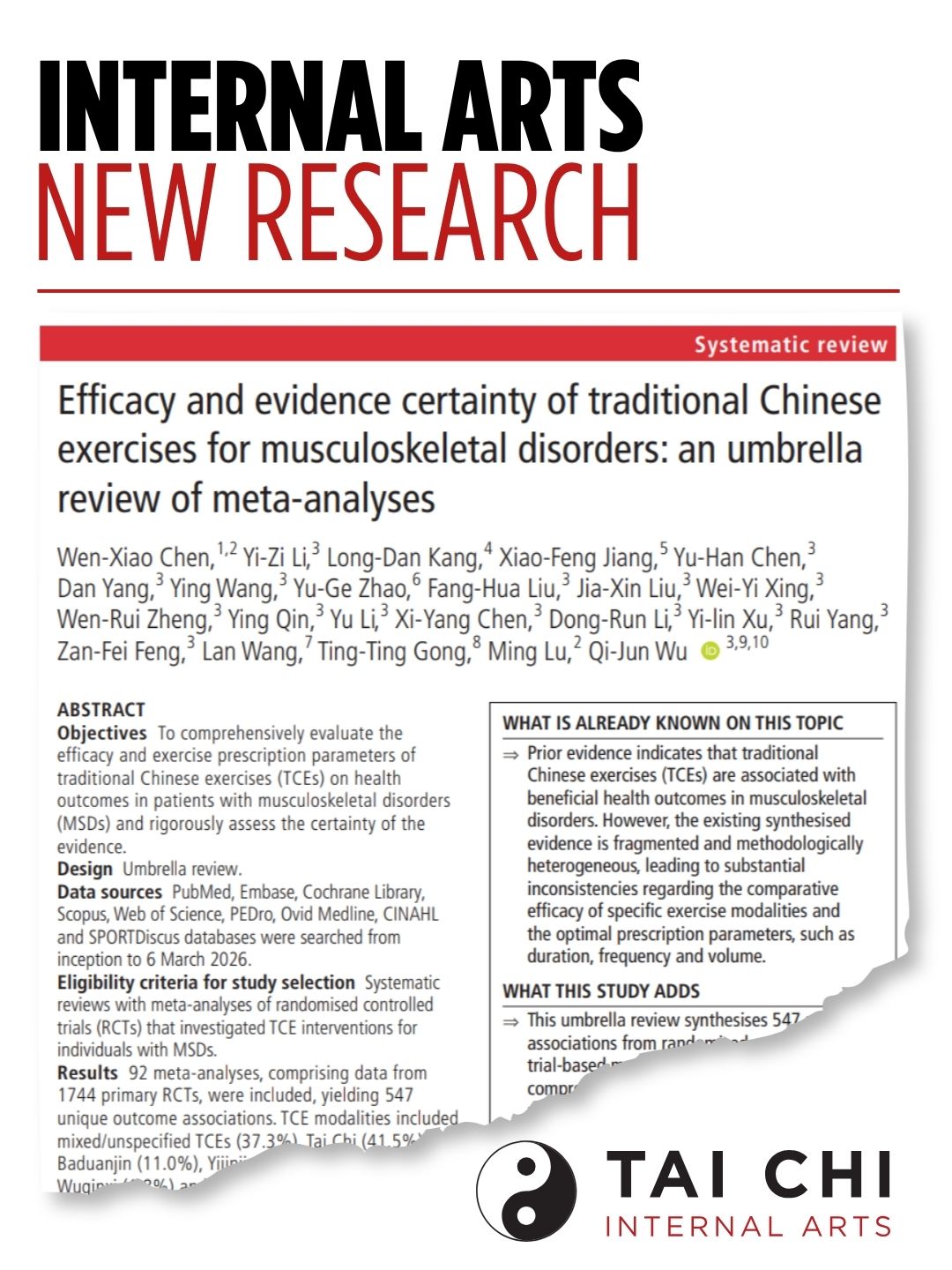
A new study published in the British Journal of Sports Medicine has examined the evidence for Tai Chi and other traditional Chinese exercises for the management of musculoskeletal conditions.
The paper was an umbrella review that assessed 92 existing systematic reviews and meta-analyses, which together comprised 1,744 randomised controlled trials.
The conditions assessed included osteoarthritis, osteoporosis, chronic back and neck pain and fibromyalgia. Tai Chi accounted for the largest identified individual exercise category, representing 41.5% of the exercise interventions examined.
Among the findings relating specifically to Tai Chi, the review reported evidence of reduced chronic musculoskeletal pain and stiffness and increased bone mineral density in people with osteopenia or osteoporosis. Across the wider group of traditional Chinese exercises, high-certainty evidence was also identified for outcomes including physical function in knee osteoarthritis, mental health in people with knee osteoarthritis and neck pain, and sleep quality in fibromyalgia.
Teach tai chi? Get recognised.
Show students that your teaching has been independently assessed by the Tai Chi Internal Arts Union.
- Accredited Instructor status
- Instructor profile
- Professional support
APPLY NOW
The researchers also looked at the relationship between the amount of practice and outcomes. For knee osteoarthritis and osteoporosis, their analysis found greater benefits associated with longer programmes, more frequent practice and greater weekly exercise volume, with some findings favouring programmes lasting six months or more, practice at least three times per week and 150 minutes or more per week.
Of 547 different associations examined, 23 were judged to have high-certainty evidence and 179 moderate-certainty evidence. Around 71% of the included meta-analyses were rated as being of high methodological quality.
As with any review of existing research, the findings depend on the quality and consistency of the studies on which it is based, and the strength of evidence varied considerably between outcomes. The study does, though, provide an unusually broad assessment of the current research and distinguishes between findings supported by stronger and weaker evidence.
The full study, Efficacy and evidence certainty of traditional Chinese exercises for musculoskeletal disorders: an umbrella review of meta-analyses, was published in the British Journal of Sports Medicine in 2026.