
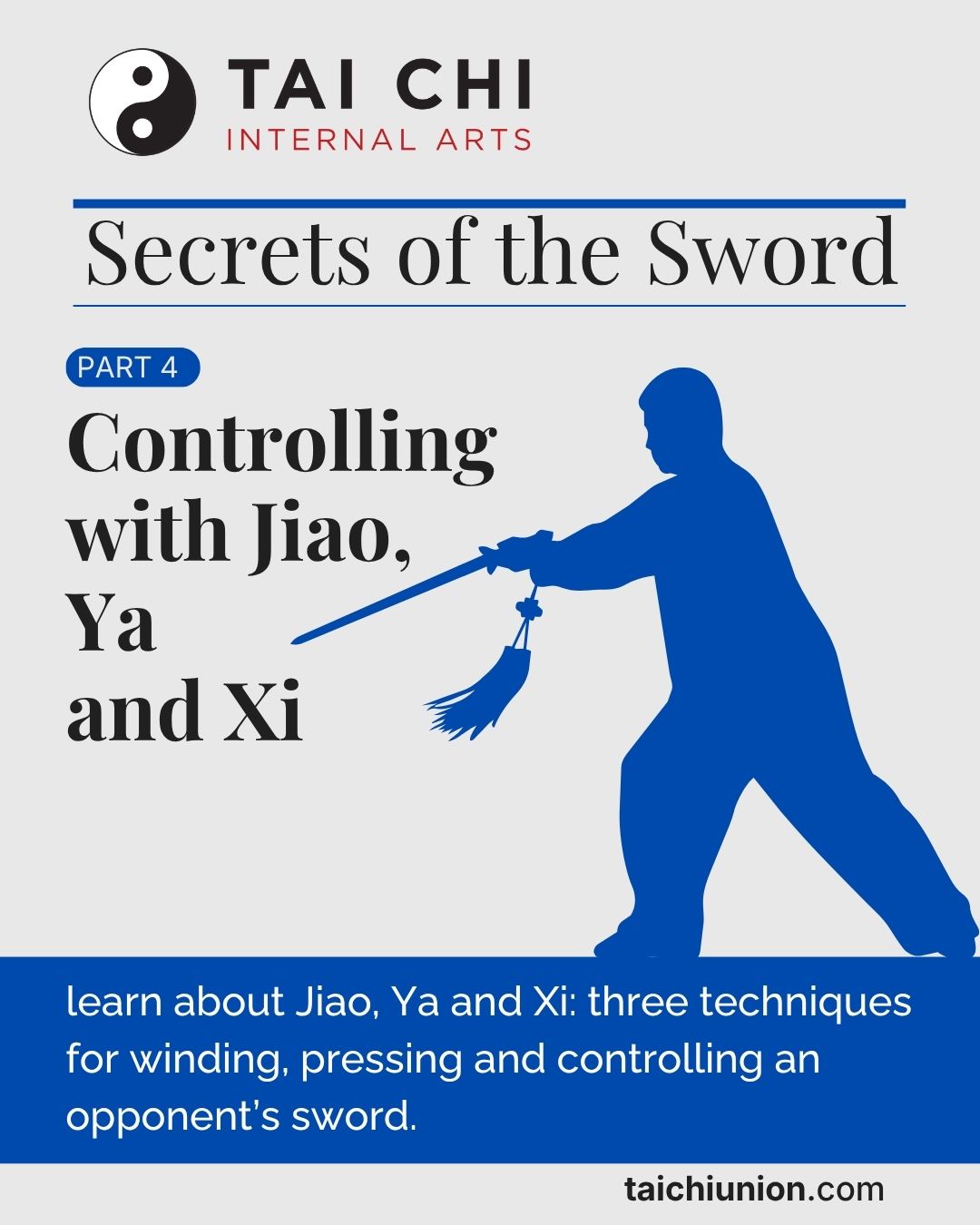

Part 4 of 9 · Article Series
Secrets of the Sword
This article is part of our 9-part series on the techniques of the sword in the Internal Arts.
Parts are being released weekly so check back regularly to read the latest instalment.
Another very useful straight sword skill that you can practice alone or with a partner is Jiao (pronounced “jeeow”). This is a kind of stirring or winding action, as you may recall from the last article in our Journey through the Jins series.
With your sword pointing horizontally in front of you, you can rotate it in a circular manner. The pivot point of the winding can be at the hilt, so that the point forms large circles in the air while only the hand and wrist move in response to the circles within the dantien; or it can pivot at some point along the length of the blade, so that the hand and arm move in slightly larger circles and the sword forms smaller circles as the pivot point moves nearer to the tip. The highest level of skill is where your control of the sword allows you to keep the tip of the sword in one place as the hand draws large circles with the hilt. This degree of control and precision increases the likelihood of being able to strike a chosen target in a real fight. You can practice it by asking your partner to hold the point of the blade still while you rotate the sword, or you can practice it by yourself with the tip immobilised by touching something solid like a wall.
Teach tai chi? Get recognised.
Show students that your teaching has been independently assessed by the Tai Chi Internal Arts Union.
- Accredited Instructor status
- Instructor profile
- Professional support
APPLY NOW
In partner-work, two people face each other with their swords touching, about halfway along the blade. As a first exercise, one holds their sword relatively still while the other circles it with their sword, clockwise or counterclockwise. Having amicably taken turns at this, the next step is for both partners to attempt to control the circling of the sword, which brings us to a technique you need in order to gain the upper hand in that situation. The technique is called Ya (pronounced “yarr”), and it involves using the flat part of the blade to press your opponent’s weapon down so that you can reverse the direction of the Jiao and take back control. This is easier to apply with the part of your sword nearer to the guard, and less effective at a longer range where only the furthest few inches are attempting to take control, therefore sliding the sword forwards along the opponent’s weapon can create an advantage in this drill.
You can practice this as a stationary exercise and then go on to move forwards and backwards at will. Jiao and Ya are therefore essential skills that you may have seen in classic movie duels over the years, though in real sparring, rather in than this simple drill, you are unlikely to just keep sticking and stirring for long before one of you tries something else.
Another technique that can potentially control the opponent’s weapon involves the use of Xi, which we discussed in the last article, though this needs a high level of skill and is quite a risky manoeuvre. As you bring the sword tip downwards in front of you, the guard can potentially be used to intercept the opponent’s blade and hook it so that, as it rises in a clockwise circle, the opponent’s sword is momentarily trapped, overturned and deflected to your right, and you can perhaps use your free left hand to control their sword arm as you counterattack.
This availability of your free hand to be used in the application of such techniques is one of the great strengths of Chinese sword, though it is more often used in broadsword (dao) than in jian.
Now, having practiced the above drills and being more accustomed to the feel of working with a partner, our next step will be to look at four ways of intercepting an opponent’s weapon, all of which are types of a thing called Ge (pronounced “gerr”) which, potentially, can allow us not only to thwart their attack but also to progress very naturally into a whole bunch of follow-up techniques which you can easily remember as you continue with your training.
Enjoy tai chi? Join the community.
Join fellow practitioners and get more from your interest in tai chi and the internal arts.
- Magazine and back issue archive
- Free T-shirt
- Members' community
EXPLORE MEMBERSHIP
Meanwhile, perhaps have another look at your own sword form and see how many times you use Jiao and Ya and Xi. If you are really interested, you might even like to look at videos of sword forms from other styles and systems and start to recognise these techniques there too. Just as the Tai Chi principles underlie everything you do in the Chinese internal arts, the thirteen straight sword techniques can be found wherever you look and not just in Chinese sword but in martial arts worldwide. After all, there are only a certain number of things you can do with a sword, and if it works, it works.