

Part 5 of 9 · Article Series
Secrets of the Sword
This article is part of our 9-part series on the techniques of the sword in the Internal Arts.
Parts are being released weekly so check back regularly to read the latest instalment.
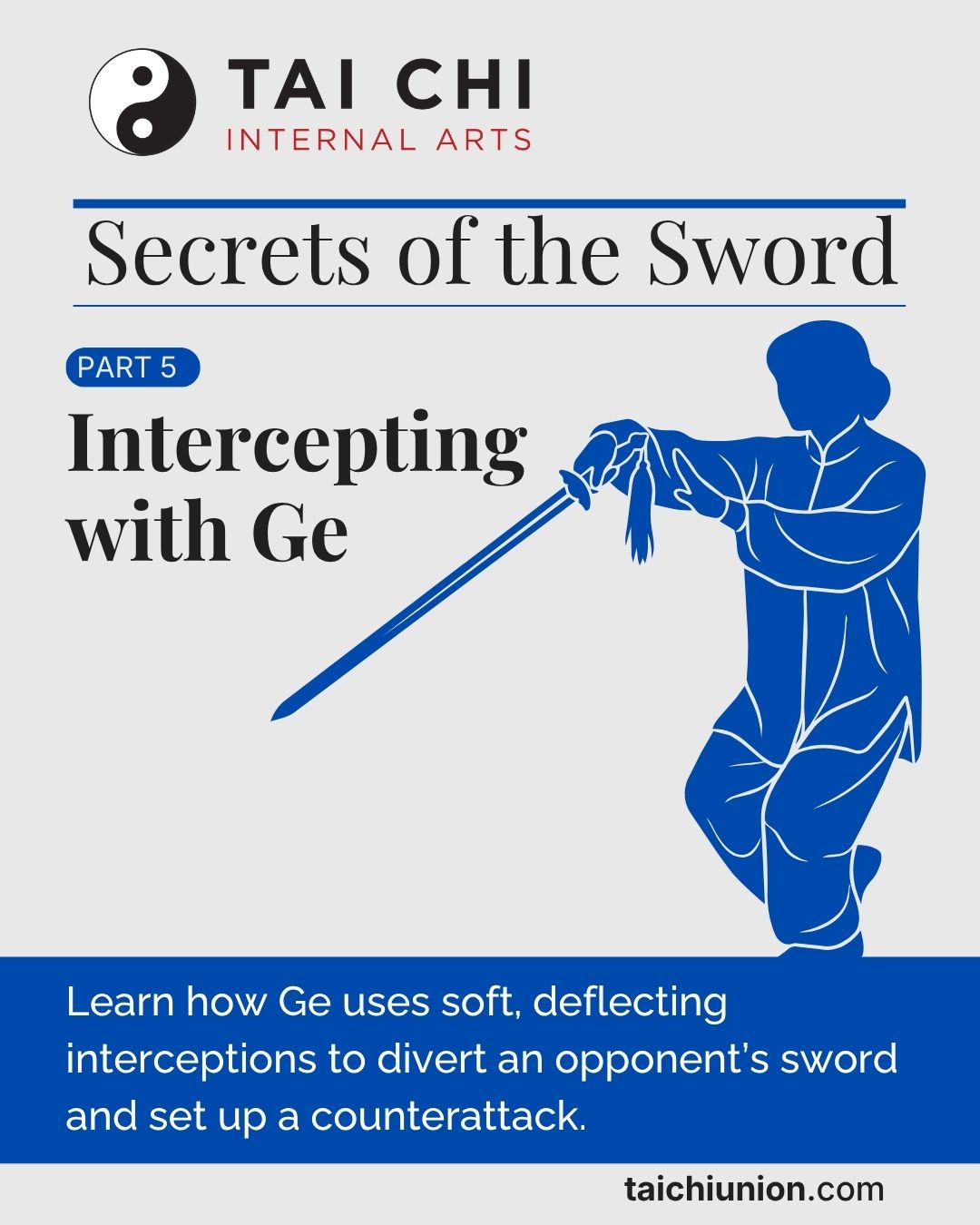
There are four basic types of Ge (pronounced “gerr”). They are all soft parries in which the flat of your blade intercepts your opponent’s incoming weapon and diverts it sideways. For two of these varieties of Ge, the sword is pointing vertically or diagonally downwards in front of you, while the other two have the sword pointing vertically or diagonally upwards.
In both cases, the sword can move to your right or left, depending on where your opponent’s sword is, how high or low it is and the angle at which it is approaching your body. The sword will not be literally vertical but will be at a slight angle towards your opponent, depending on how far away their sword is. Judging this distance is called “gaining the measure” in which you assess where you need to be in order to successfully intercept their weapon and follow through with your counterattack without moving in close enough to put yourself in more danger. It is important to intercept using the lower half of your sword, if you can, close enough to the hilt to allow you to control the opponent’s weapon. Attempting Ge with the thin tip of your sword is likely to be ineffective.
Teach tai chi? Get recognised.
Show students that your teaching has been independently assessed by the Tai Chi Internal Arts Union.
- Accredited Instructor status
- Instructor profile
- Professional support
APPLY NOW
From the movies, you will no doubt have seen fights involving the clash of steel on steel as the combatants bash each other’s swords this way and that, risking shattering or blunting their blades in the process. Ge is very different. It is a softer, deflecting interception with either a sliding or beating action that diverts the incoming weapon, after which your sword may detach from the opponent’s weapon or stick to it and keep moving so that it slides off the end. Either way, it is free to circle around upwards, downwards or sideways, in much the same way as we discussed in the section on the figure of eight drill. In fact, the Ge itself can come off such a loop in the first place and simply continues on its way as it deflects the opponent’s weapon and sets up your counterattack.
In all cases, it can be wise to remember that you have legs. While it is possible to practice these moves with an obliging partner while both of you are standing still, a quick sidestep can help immensely in achieving a successful outcome. In a real fight, never underestimate the speed at which an opponent can thwart your best game plans by simply dodging out of the way or just moving their sword in a direction you never expected, which is all the more reason for you to be nimble and quick. Also, some moves involve stepping forwards or backwards as you advance or retreat, so we will be looking at this later.
What happens at the end of a Ge interception will depend on whether your sword is pointing up or down and the direction in which it is moving, so that’s what we will be looking at next.
Meanwhile, you can now re-examine your sword form to discover how many times you recognise an upwards or downwards Ge within it. Even more interestingly, you can look at where it goes from there. Does it stop suddenly or does it immediately and smoothly loop around into something else?
Enjoy tai chi? Join the community.
Join fellow practitioners and get more from your interest in tai chi and the internal arts.
- Magazine and back issue archive
- Free T-shirt
- Members' community
EXPLORE MEMBERSHIP
In the next article, we will look at which of the thirteen sword techniques can be very useful when following on from a downward Ge to your left or to your right, all of which provide you with a range of methods for disarming your opponent. As is traditional, we will assume that both you and your opponent are right-handed in all of the following explanations. The position of the sword for a downward Ge is also known as a classic “hanging guard”. If you hold your sword out in front of you and rotate your forearm inwards so that your blade is hanging downwards towards the floor, that’s a hanging guard. It can be held high or low and it can slope a little so that it shields your body from your right shoulder to your left hip or knee, depending on the length of the sword. From that position, your arm can move to your right or left to intercept an incoming mid-level or lower-level attack.