

Part 7 of 9 · Article Series
Secrets of the Sword
This article is part of our 9-part series on the techniques of the sword in the Internal Arts.
Parts are being released weekly so check back regularly to read the latest instalment.
- Introduction to 13 Sword Techniques
- Controlling the Sword
- Shielding with your Sword
- Controlling with Jiao, Ya and Xi
- Intercepting with Ge
- Following on from Downward Ge
- Following on from Upward Ge
- Moving Forwards, Backwards and Sideways (coming soon)
- Variations in Different Styles and Systems (coming soon)
Whether you are engaged in bare hand combat or duelling with swords, the process of intercepting, following, interpreting and issuing is quick, smooth and intuitive. When you intercept with Ge, there is simply no time to block or deflect the incoming weapon then decide whether to detach from it or to stick to it, slide forwards or backwards, then pause to think about what you’d like to do next.
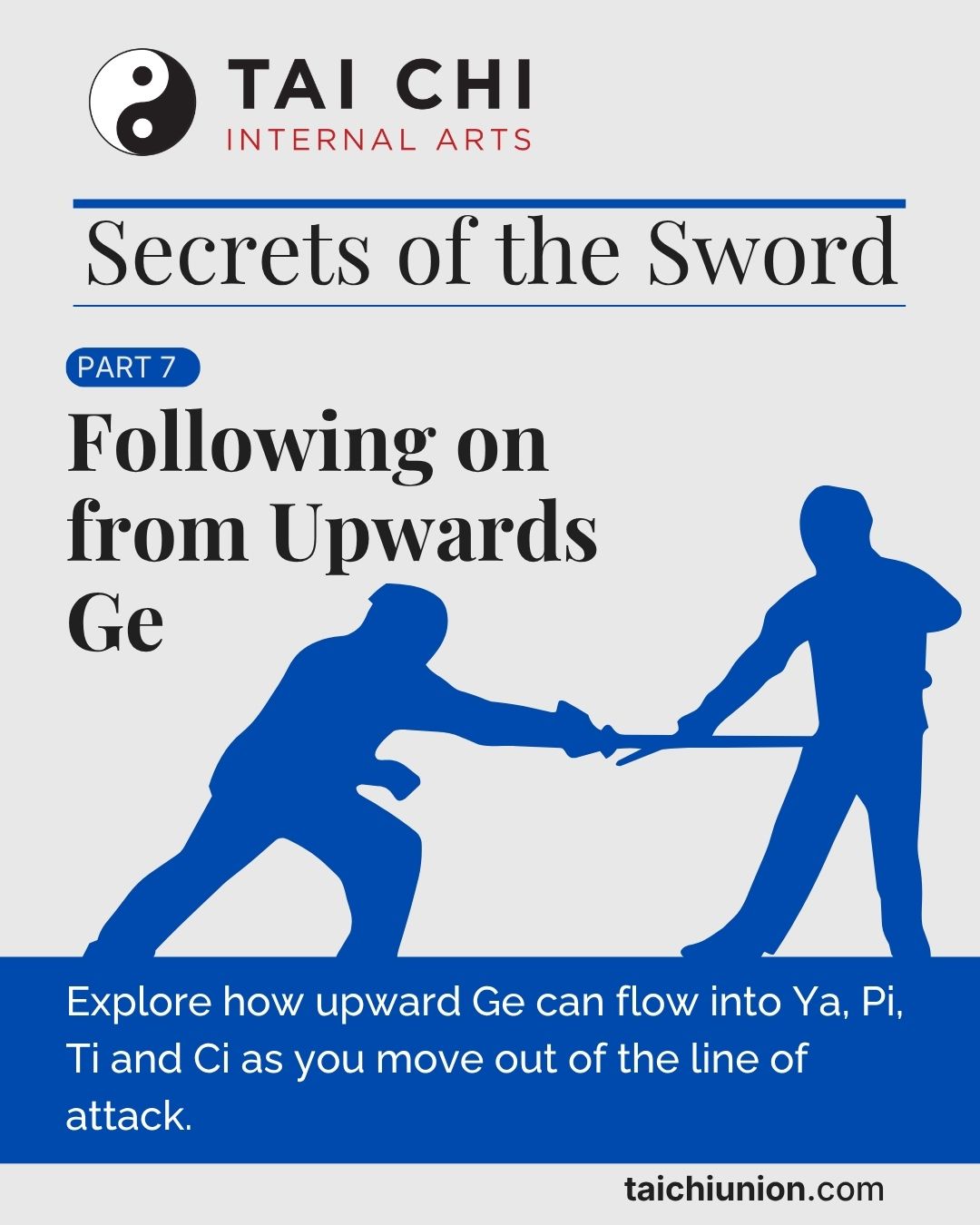
With an upward Ge, your opponent’s weapon is heading towards your heart or your face, so the flat of your blade needs to intercept it and deflect it to your left or right, perhaps with a sidestep in the opposite direction, to get you out of their line of attack as quickly as possible.
From an upward Ge to your right, in which your upwards-pointing sword has intercepted theirs with the flat of your blade and can press it sideways and overturn it with Ya, you already have the upper line of attack at that point (your sword is on top of theirs) and you are on their outside, away from their free hand, so there is no need to slide and loop around backwards at that point as their neck is exposed and you can simply walk forwards, allowing the sword to follow you in a slicing motion. You can even control their sword arm with your free hand as you do this.
Teach tai chi? Get recognised.
Show students that your teaching has been independently assessed by the Tai Chi Internal Arts Union.
- Accredited Instructor status
- Instructor profile
- Professional support
APPLY NOW
Upward Ge to your left can present you with a slightly more difficult challenge. At a suitable range, it can be thought of not as a hard clash but as softer contact that can beat their sword away from you and, perhaps, allow your sword to slide backwards along theirs and loop around to strike their sword arm from underneath, or to whip upwards and over to come down on their arm with Pi. Anything involving stepping in closer, however, carries a much greater risk.
So far, we have focussed almost exclusively on attacking the hand or arm, as if these were the only targets to consider. However, another obvious target, if you are fighting for your life, is the body of the person attacking you. The techniques to consider here are not meant to merely disarm the opponent but to end the fight.
In practice, however, this is way trickier than it sounds. For one thing, from a left upward Ge, you are on the inside of the opponent’s sword arm, which means that you are within reach of their free left hand or fist, while your own free hand is on the wrong side of both their blade and yours. Any attempt of yours to use your own free hand to control their sword arm as you make your next move is likely to leave your arms trapped against your body and risk injury from your own sword, let alone theirs.
If you manage to beat their sword off to your left as you step away from it to the right, it might be possible to follow through from an upwards Ge to your left by looping around with a large, diagonal upward slice (Ti – pronounced “tee”, or Liao – “leeow”) to the arm or torso. This might be possible with a cooperative partner but is otherwise very risky and you would have to be very quick to have any chance of reaching your target before they recover from your Ge and retaliate.
Enjoy tai chi? Join the community.
Join fellow practitioners and get more from your interest in tai chi and the internal arts.
- Magazine and back issue archive
- Free T-shirt
- Members' community
EXPLORE MEMBERSHIP
Which brings us to the wisdom of wearing protective body armour during any kind of sparring with swords. From experience, however, it appears that, the more armour people wear, the more unwise risks they tend to take. Even a very blunt sword can cause injury, so caution and respect are always necessary in martial arts, and the head or neck should never be targeted without restraint, even if helmets and masks are used. A heavy wooden sword on a helmeted head can still cause concussion.
A less obvious follow-on from an upwards Ge to the left and gaining control with Ya or Jiao, is to actually slide forwards along it (rather than backwards and looping around) to thrust with Ci (pronounced “tser”). However, a lunging thrust can leave you momentarily over-committed and vulnerable if you don’t quite pull it off. You would need to be very skilled and confident that you have full control of your opponent’s sword or arm before risking such a bold move.
Stepping forwards with a lunge is another reminder that, in a fight, your feet (and those of your opponent) are not normally glued to the floor. You can remember that you are free to move forwards, backwards or sideways as befits the situation, as we will see as we explore the last few techniques on our list of thirteen, before going on, in the remaining articles of this series, to take a quick peek at broadsword, consider variations in other styles and systems and finish with some further insights to help you on your journey towards becoming a sword master.
Meanwhile, do continue to explore how the skills you have learned about so far might be already incorporated in your sword form. The large, upward sweeps of Ti and the long lunges of Ci and crashing downwards chops of Pi are particularly likely to be present, and easy to spot, in most sword forms.