
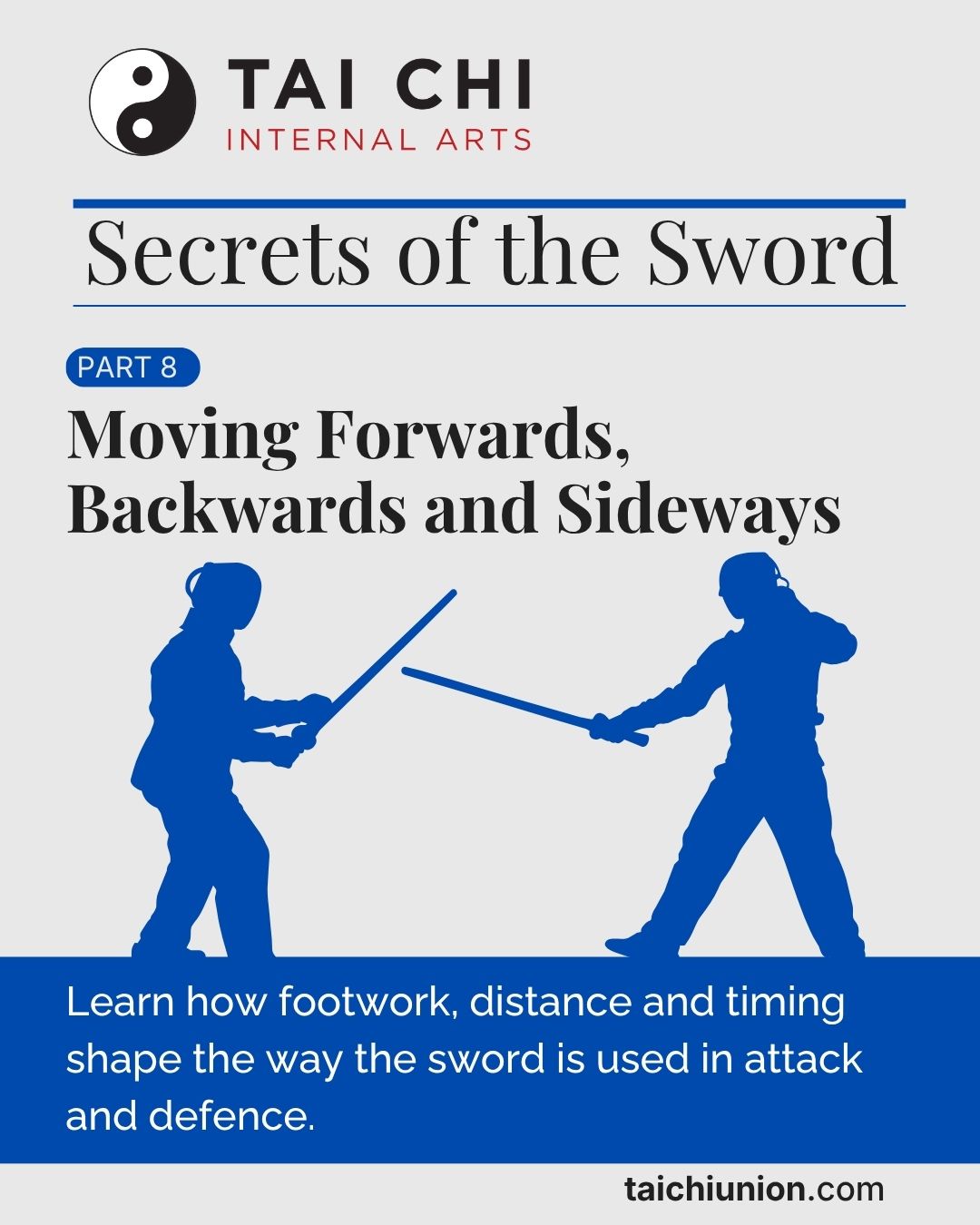

Part 8 of 9 · Article Series
Secrets of the Sword
This article is part of our 9-part series on the techniques of the sword in the Internal Arts.
Parts are being released weekly so check back regularly to read the latest instalment.
- Introduction to 13 Sword Techniques
- Controlling the Sword
- Shielding with your Sword
- Controlling with Jiao, Ya and Xi
- Intercepting with Ge
- Following on from Downward Ge
- Following on from Upward Ge
- Moving Forwards, Backwards and Sideways
- Variations in Different Styles and Systems (coming soon)
Having already mentioned most of the thirteen straight sword techniques - namely Jiao, Ya, Ge, Ji, Chou, Dian, Beng, Ti, Pi, Xi and Ci - there are only two more remaining to be introduced, namely Dai (pronounced “dye”) and Jie (pronounced “jierre”, rhyming with the name Pierre).
Dai is a cut that you apply as you move backwards, away from the opponent, perhaps when your forward attack has been thwarted but your sword can still connect with any part of the body as you back away.
Jie is perhaps the most difficult of all the thirteen techniques. It requires very nimble footwork in order to step sideways, dodge their weapon completely and attack their sword arm directly, rather than making any contact with their sword.
Teach tai chi? Get recognised.
Show students that your teaching has been independently assessed by the Tai Chi Internal Arts Union.
- Accredited Instructor status
- Instructor profile
- Professional support
APPLY NOW
Moving forwards to attack the body is risker than keeping your distance and aiming to strike the sword arm. You might still use a downward Ge to your left to set up a large, circling downward Pi to the neck, head or shoulder; or an upward Ge to set up a diagonal (Ti) or sideways sweep (Chou) across the torso. Chou is a slicing action from any place where the sword is in contact with the opponent’s body. Ti can be used in large forward-moving diagonal sweeps across the body or as defensive arcs to intercept, lift and deflect the opponent’s sword upwards and outwards as you are backing away. You might even use Ti to attack their sword hand, then perhaps surge forwards again with more Pi, Ti, Chou or even Ci.
As you step into your opponent’s striking range or “measure”, you have to be confident that you have either disarmed them or have taken control of their weapon, and you have decisive control of the line of attack so that they are unable to retaliate as you move in with Pi, Ti, Chou or, especially, Ci.
There are endless possibilities as to how these thirteen techniques can be combined and used. Your forms, drills and sparring practice can equip you with a feel for the weapon and principles of its use, though it’s probably wise to remember that, however complex and graceful your form may be, the fancier the technique you have in mind, the less likely it is to be effective against a determined assailant. As with all martial arts, conditioned responses tend to win out against intellectual deliberation.
In a fight, the important thing is survival and making use of what actually works in the situation you are in, without too many preconceived ideas and expectations to slow you down or stop you long enough for your opponent to defeat you. Therefore, in the end, once you have practiced and understood these basic sword skills, the idea is to forget them! Learning, practicing and understanding the details of any art is very enjoyable in itself, but it’s a bit like learning where the notes are on a piano. There may come a time when you begin to feel the music itself and trust your fingers to know where to go.
Enjoy tai chi? Join the community.
Join fellow practitioners and get more from your interest in tai chi and the internal arts.
- Magazine and back issue archive
- Free T-shirt
- Members' community
EXPLORE MEMBERSHIP
There is a very famous story told in martial arts circles. In one version of this, a school is under attack by a large group of armed assailants. The elderly teacher only has his least experienced student with him, and he has very little time to teach him anything before the attack begins, but he shows him thirteen sword techniques as a fluid sequence and asks him if he can remember it. The student shakes his head apologetically and admits he can’t remember any of it. With a satisfied smile, the master says: “Good. You’re ready then!” and they go outside together to defeat all the attackers.